At 90, His Holiness the Dalai Lama Embodies What the 21st Century Can Be—Conscious, Compassionate, and Peaceful

This July felt historic—spiritually, emotionally, and politically.

On July 2, His Holiness the 14th Dalai Lama affirmed the continuation of the Dalai Lama institution, declaring that the 15th Dalai Lama will be born in the free world. That announcement, coming straight from him, felt deeply reassuring. It honored the heartfelt appeals of Tibetans and global followers alike—and rekindled hope for our people, our culture, and future generations in the 21st-century world.

Then came July 6, the 90th birthday of His Holiness. And in true Dalai Lama spirit, he didn’t just receive wishes—he fulfilled them. He expressed a wish to live for another 40 years—until the age of 130—so he could continue serving the Buddha Dharma and the Tibetan people. It was a joyous, humbling moment, a powerful assurance to Tibetans—especially those inside Tibet—and to millions around the world, that the light will continue to shine on.

And on July 10, something truly special happened in my home state, Massachusetts,

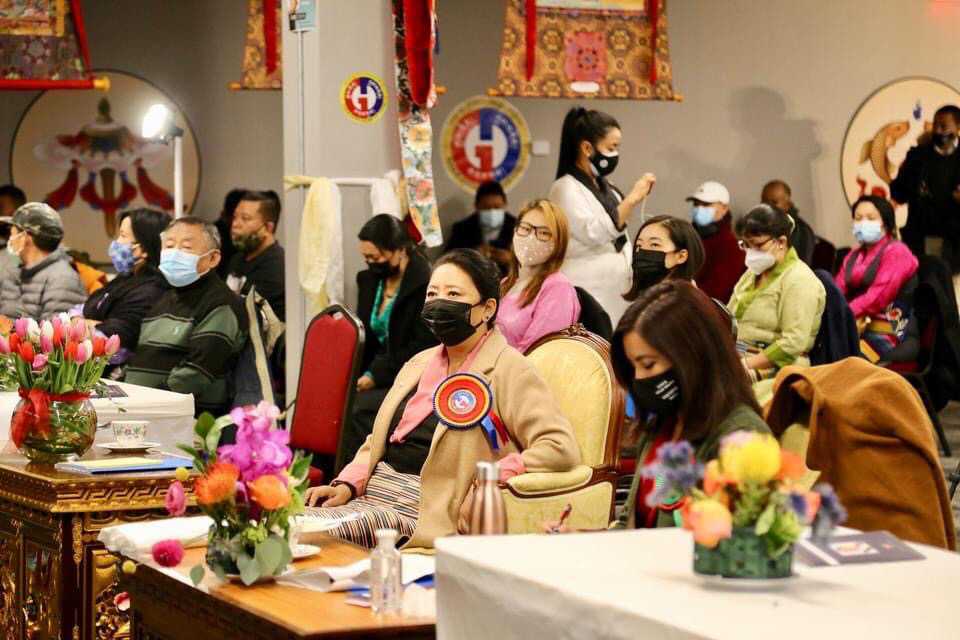
For the first time ever, the Massachusetts State House opened its doors to officially honor His Holiness’s 90th birthday. Lawmakers from U.S. Congress and the Massachusetts Legislature, representatives from the Governor’s Office, and leaders and members of the Tibetan American community came together to mark this milestone and to officially launch the Global Year of Compassion, a worldwide initiative led by the Central Tibetan Administration.

This was no ordinary gathering. Co-hosted by the Tibetan Association of Boston (TAB) and the Regional Tibetan Association of Massachusetts (RTAM)—and co-sponsored by Senator Jo Comerford, Representative Lindsay Sabadosa, and Representative Mindy Domb—this event represented something deeply personal and deeply political. It felt like a spiritual homecoming for the values that His Holiness has spent a lifetime embodying.

Coming on the heels of His Holiness’ historic announcement regarding his reincarnation, the event carried profound significance. It wasn’t just a birthday celebration—it was a declaration of purpose. In a world fractured by war, authoritarianism, and division, His Holiness’s values—compassion, nonviolence, and interdependence,—shine like a beacon.

As Massachusetts raised the banner of compassion, the message rang loud and clear: the world needs more of what His Holiness represents.

With the Year of Compassion now officially underway, Tibetan communities across the globe—beginning here in Massachusetts—will continue carrying His Holiness’s message forward through acts of service, environmental stewardship, interfaith harmony, and grassroots justice work.

As His Holiness has said:

Compassion must be practiced—not merely praised.”

You can watch the full event via Tibet TV’s livestream.

My Remarks at the State House

Note: The excerpts below are adapted from my remarks and have been lightly edited for clarity and flow.

Standing at the podium, looking out at a room filled with allies, lawmakers, and fellow Tibetans, I felt a deep sense of purpose. Below are a few reflections I shared that day:

“On July 2nd of this year, just last week, His Holiness the 14th Dalai Lama affirmed the continuation of the institution of the Dalai Lama—meaning the 21st century will welcome a 15th Dalai Lama. The 21st century world will bear witness to the continuation of the legacy of the great 14th Dalai Lama—his commitment and life’s work for peace, compassion, and an equitable, more sustainable humanity.

In today’s troubled times—amidst deepening political divides, competing belief systems and a world torn by war—the Dalai Lama’s unwavering light of wisdom and compassion comes as a silver lining. And today’s event affirms that.

This gathering is historic. It is the first time an event honoring His Holiness the Dalai Lama is taking place inside the State House, right in the heart of the Commonwealth of Massachusetts. It is a privilege for both the Tibetan Association of Boston and the Regional Tibetan Association of Massachusetts to be organizing this occasion.

As a Tibetan, I often find myself at a loss for words when trying to articulate what His Holiness means to me and to the Tibetan people.

Personally, he is my root guru—my moral compass.

For the Tibetan people, especially the six million inside Tibet, His Holiness embodies the sun and the moon—guiding us with integrity and moral clarity.

To the world, he is a beacon of hope, a force for good, and a champion of compassion and wisdom.

Today’s event also marks the official launch of the Year of Compassion, a global initiative of the CTA.

For the 21st-century world, His Holiness has not only proposed a conceptual framework for compassion—he has institutionalized it through his life’s work and teachings.

Thanks to His Holiness, compassion is now a working model—one that is urgently needed in our time.

Though he is the spiritual leader of Tibetan Buddhism, the world sees His Holiness as a secular moral leader. One of his teachings that has resonated across religious traditions is this:

 “My religion is simple—my religion is kindness.”

The Year of Compassion allows every Tibetan in the free world—and everyone who resonates with His Holiness’s vision—to embody kindness, not just preach it.

Through events, acts of service, and interfaith and intergenerational engagement, we will carry this message forward.

The Year of Compassion has offered us not just an aspiration but a framework for empowerment, rooted in practice and purpose. It brings us closer to the fulfilment of His Holiness’ vision of the world—one that, in his own words, is:

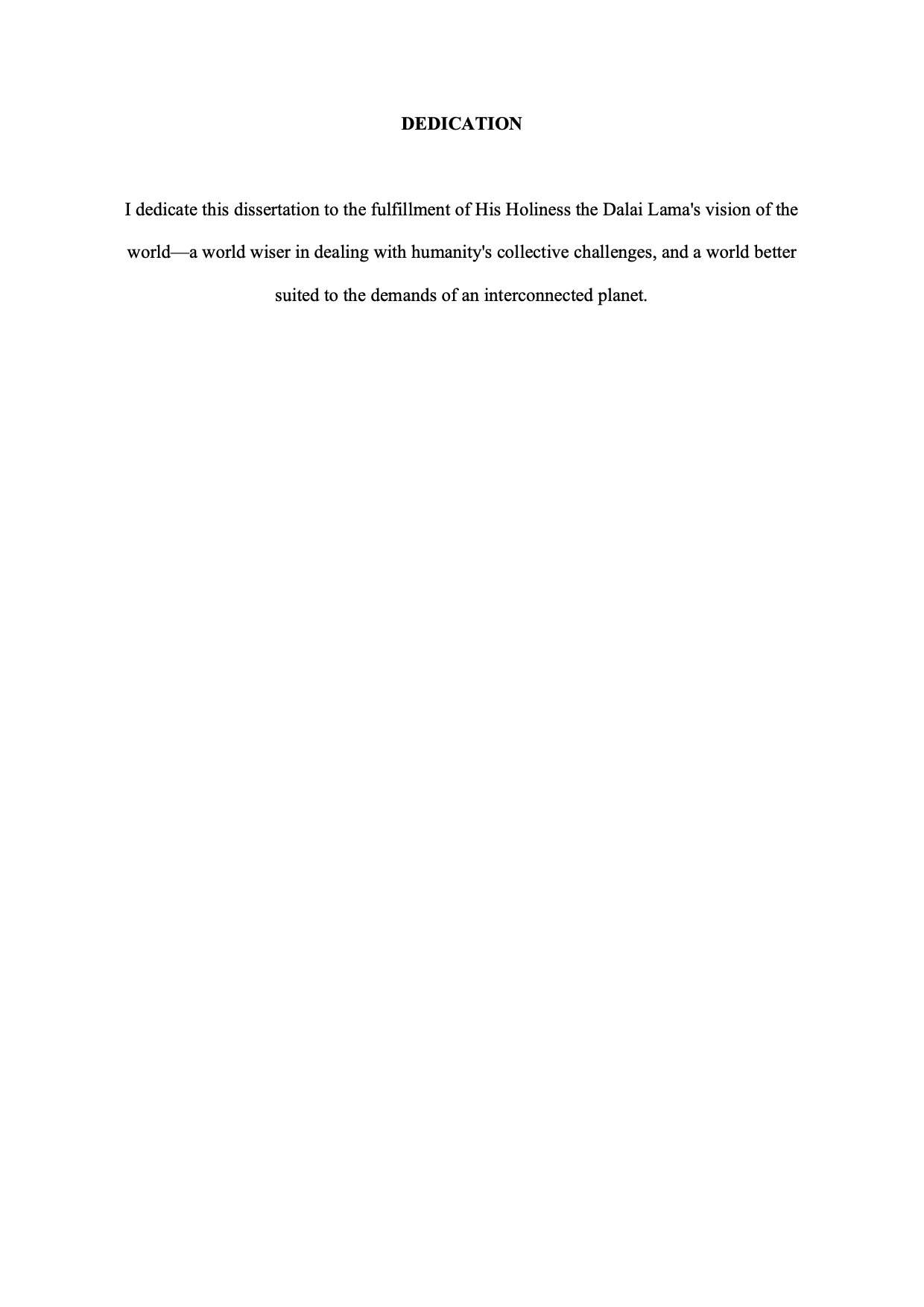
“A world wiser in dealing with humanity’s collective challenges, and a world more suited to the demands of an interconnected planet.”

That is the benchmark set for us, and we all have work to do!”

You can watch the video of my remarks on my YouTube Channel.

Is 2025 the Beginning or the End?

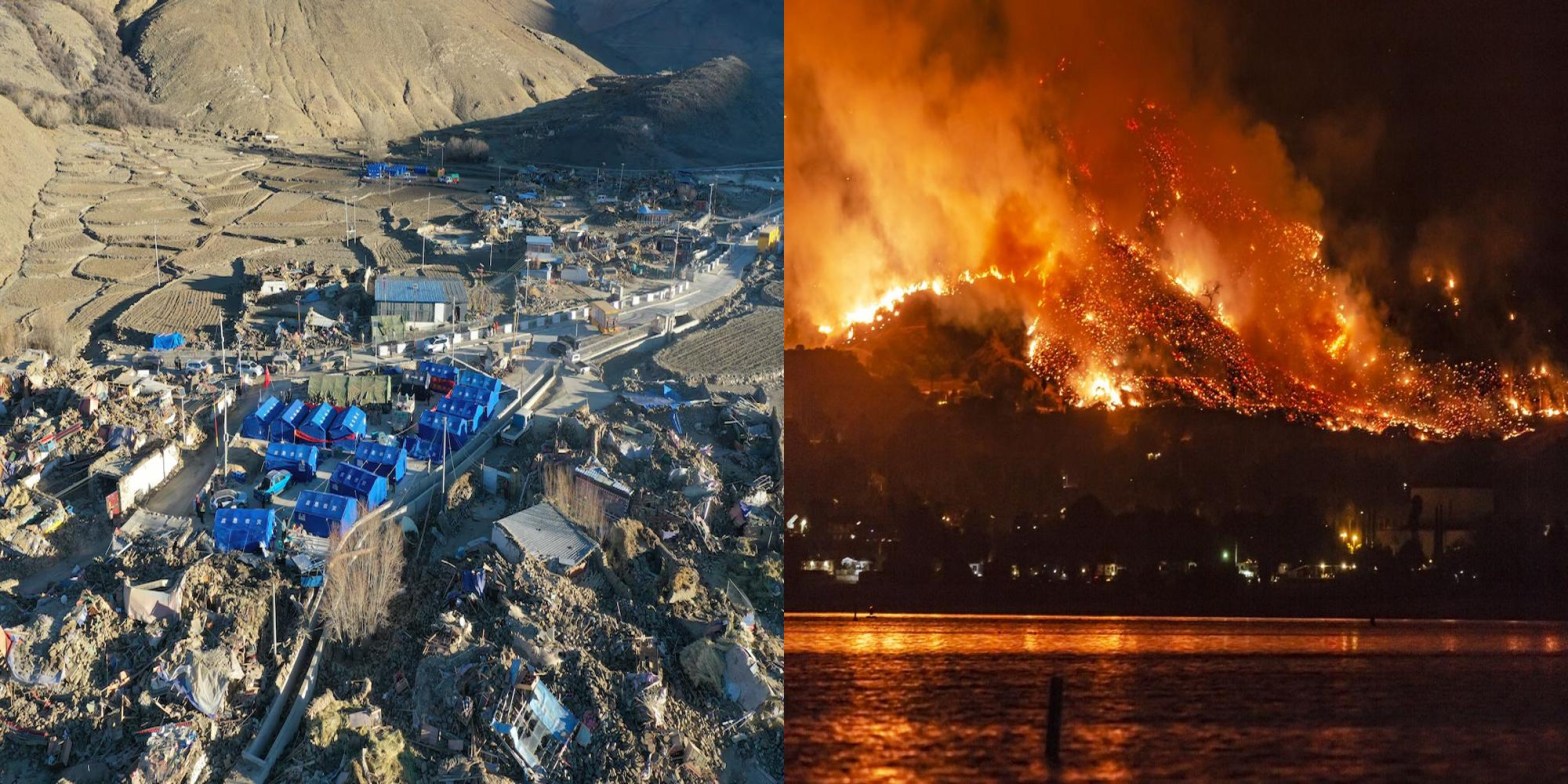
The image on the left shows the aftermath of the earthquake in Tibet and the image on the right depicts the wildfires in California

Within the first week of 2025, we have already witnessed devastating calamities—an earthquake in Tibet with 500 reported aftershocks and wildfires in California, both with minimal chances of containment. The earthquake in Tibet highlights the intersection of colonial harm, where censorship of information and the use of Chinese names instead of Tibetan ones obscure the actual impact. Additionally, constructing mega dams in a highly seismic region on a geological faultline amplifies the risks. Meanwhile, capitalist development designs and inadequate environmental regulations in California have exacerbated the wildfires. The climate crisis has now fully invaded our homes and lives, making urgent action imperative before it becomes unmanageable.

These disasters reflect Mother Nature’s backlash against colonial, capitalist, and heteropatriarchal systems that have long exploited the Earth and its resources. This theme was explored in our book, The Power of the Feminine: Facing Shadow, Evoking Light (2020), where authors from Egypt, Ghana, Exile Tibet, and the United States emphasize dismantling patriarchal and colonial behaviors that have deeply shaped political, economic, and religious paradigms. Colonization has inflicted lasting harm on people of color, indigenous cultures, and natural resources. Indigenous peoples, who have preserved a balanced relationship with Nature while respecting all species, offer vital guidance. The book highlight the need for change: face the human shadow, heal oneself and foster healthier ways of living and relating to ensure a sustainable future for all generations.

Unlike the onset of 2020, marked by the COVID-19 pandemic from which we eventually recovered, 2025 presents a climate emergency with no obvious turning point. To shift this trajectory, we must undergo a profound transformation of human consciousness. We must unite as a global community, embracing the teaching of “oneness of humanity,” as His Holiness the Dalai Lama often emphasizes. On this interconnected planet, one individual’s well-being directly affects another’s. Now is the time for decisive action to replace colonial, capitalist, and patriarchal systems with a conscious, compassionate, and resilient model that prioritizes collective well-being and harmony with Nature.

We have come very far—perhaps too far—where measures of individual and communal success are defined by capitalist gains, material wealth, and colonial power. It is time to redefine success based on inner peace, as His Holiness the Dalai Lama teaches, making it the foundation for outer peace. Human values like warmheartedness, driven by action and environmental ethics, present a viable solution for addressing the interconnected challenges of human, climate, and planetary well-being.

We still have time to make 2025 the turning point in our collective history—when humanity finally learned its lesson, with no turning back. Let 2025 mark the end of our destructive patterns and the beginning of a conscious, compassionate, and united humanity.

An Ode and a Dedication: For His Holiness the Dalai Lama on his 88th Birthday

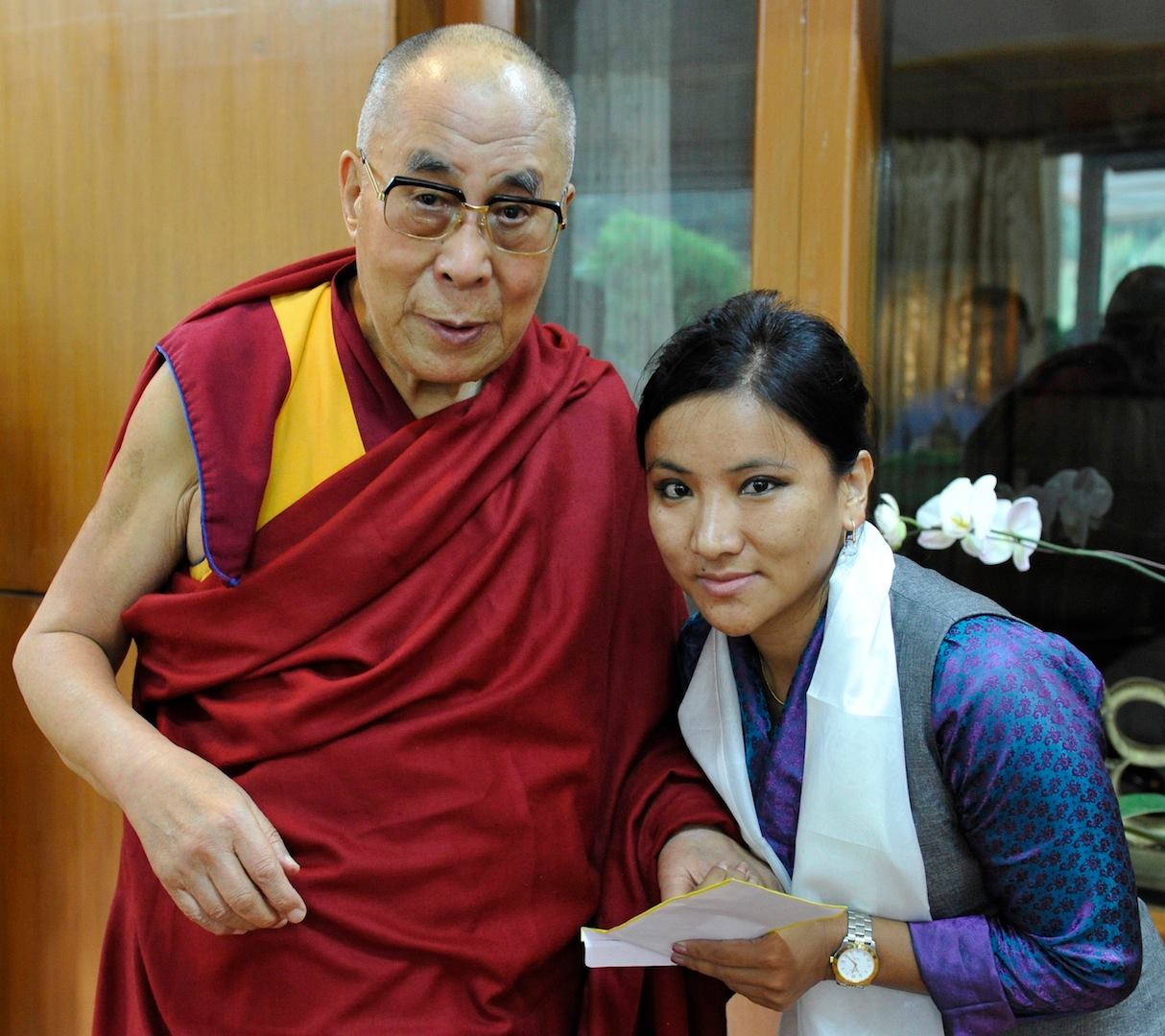
This photograph was captured on August 3, 2014, in Dharamsala, when I was graciously granted a special audience with His Holiness, which I had sought to receive his blessings before embarking on my journey to the United States for my doctoral studies. Nine years on, I feel a sense of fulfillment, as though the blessings bestowed upon me that day have beautifully come to fruition.
 Photo credit: OHHDL
 

Today, as we celebrate the 88th birthday of His Holiness the 14th Dalai Lama, I feel moved to share my reflections and aspirations, which have been profoundly molded by the life and teachings of this eminent spiritual and thought-leader.

For every Tibetan, His Holiness represents the embodiment of the moon and the sun – the guiding light that illuminates the path of righteousness. To the rest of the world, His Holiness is a beacon of hope for humanity. He is a force for good and a harbinger of compassion, peace, and wisdom.

Personally, His Holiness has been both my moral compass and my root guru. His unwavering commitment to the promotion of human values has been a wellspring of inspiration that has shaped the course of my life and the choices I made. I recall countless nights praying for the opportunity to be in a position where I could contribute, even if in the smallest way, to advancing the principles he holds dear.

With a head full of dreams and a heart full of gratitude, I ventured to the West to pursue doctoral studies after spending over a decade working as an activist and advocate for the Tibetan movement in exile India. My determination was steadfast – to contribute to the scholarship on the Dalai Lama, an area that I felt needed more voices and perspectives.

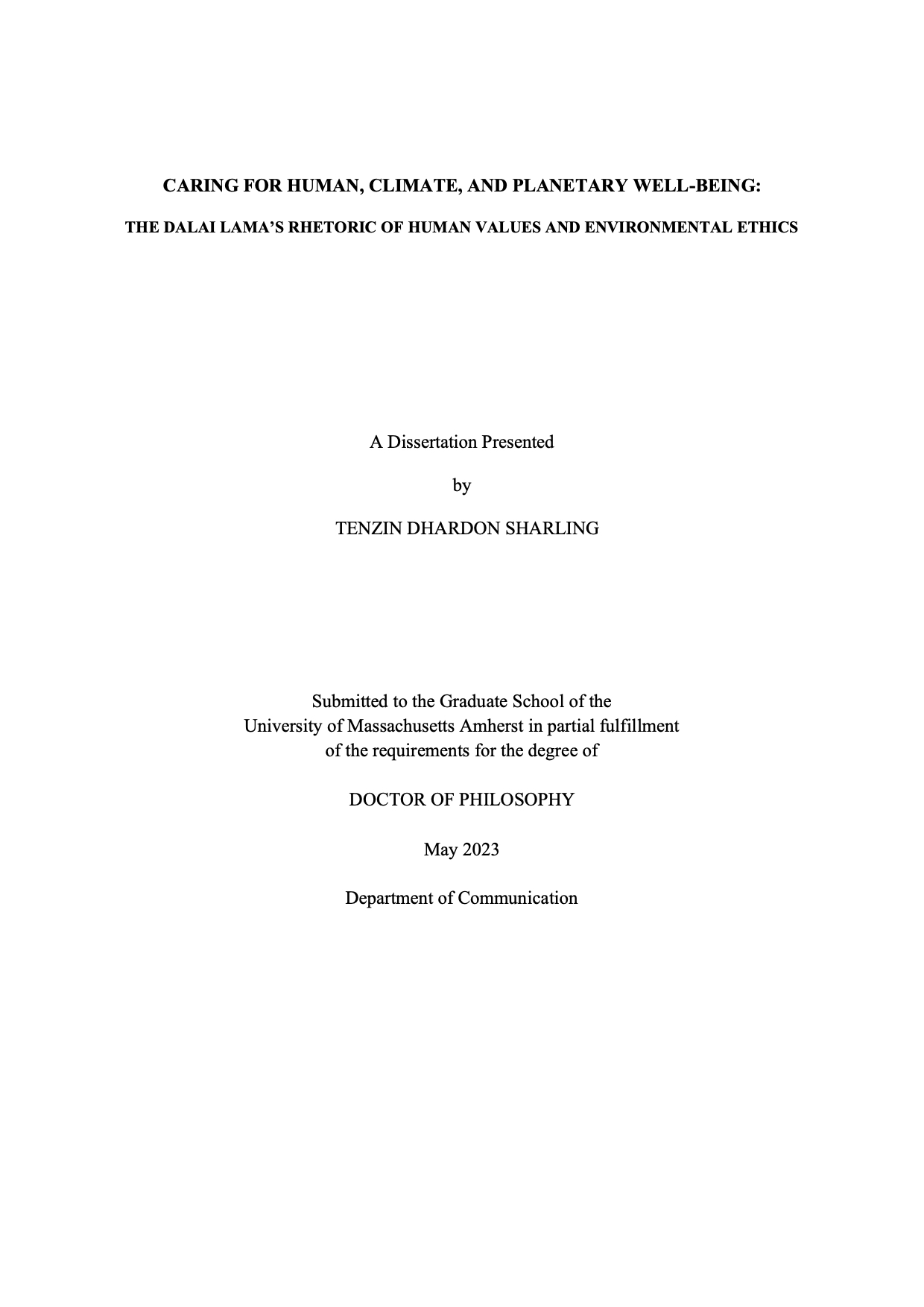
Today, it fills my heart with immeasurable joy and humility to share that I have authored a dissertation that explores the Dalai Lama’s discourse on human values, particularly during a critical moment in human history – the Covid-19 pandemic, set against the canvas of the existential threat of climate crisis. Through this scholarly pursuit, I present a unique communication perspective on the significant scientific and political conversations of our times. In doing so, my aspiration is to pave the way for interdisciplinary research that converges at the crossroads of human consciousness, communication, culture, digital mediation, and global environmental challenges.

This scholarly endeavor is more than an academic pursuit; it is a labor of love and dedication. My aspiration is for the theoretical, practical, and methodological implications of His Holiness’ rhetoric of human values to impact social change and address issues of human, climate, and planetary well-being. There is a long road ahead to transform this dissertation into a publicly accessible book and a multimedia project. The scale and scope of these aspirations can sometimes feel overwhelming, especially considering the adversities and challenges that life presents.

However, His Holiness’s enduring spirit and teachings empower me to remain steadfast and resolute in my conviction and commitment. On this auspicious day, as we celebrate his 88th birthday, I reaffirm my dedication to championing the fulfillment of his vision of a wiser, compassionate, and interconnected world.

Echoing the timeless words of Alfred Tennyson, I consider it my great fortune that since my formative years, it has been His Holiness the  Great 14th Dalai Lama who has emboldened my resolve  ‘To strive, to seek, to find, and not to yield’.

In dedication and humility,

Dhardon Sharling

July 6, 2023

A Dreamer, Believer, Doer: Why Kasur Gyari Dolma is my choice for Sikyong 2021

Kasur Gyari Dolma at the NYC public felicitation. December 5, 2020. Photo Tenzin Wangdue

In early December this year, I received an invitation to speak at the public felicitation being organized in New York City for Kasur Gyari Dolma la. I gave a 20-minute speech in Tibetan language. I thought it would serve a deeper purpose to publish the English translation of the speech in hopes of reaching out to a wider audience.

Good morning everyone, 

I am truly honored and humbled to be speaking about Kasur Gyari Dolma la (KDG), a name that represents not just an individual, but an institution, an idea or I could say a phenomenon. I can deliberate for hours about this wonderful individual, but given the limited time, I will share few short personal stories about KGD and in doing so highlight a few important traits of hers that makes her who she is.

Firstly, courage and conviction:

In August 2010, I was a young researcher at the Central Tibetan Women’s Association in Dharamsala, when I heard the news that the then Deputy Speaker Dolma Gyari la had announced her candidacy for the Kalon Tripa election of 2011. I felt jubilant and proud at the same. When phayul.com asked me for a response, I said;

 “I welcome her decision as a phenomenal breakthrough in the political empowerment of Tibetan women in the exiled Tibetan polity. Therefore notwithstanding the results, her conviction and assertion will definitely encourage the enfranchisement of the Tibetan electorate.”

It indeed was a “phenomenal breakthrough.”

Today, 10 years later, I am honored and humbled to be speaking in support of the very same person. Truly her courage and conviction has remained unparalleled in the last many decades of service to Tibet. 

KGD has repeated historic feats by being the many firsts – first female Deputy Speaker of the Tibetan parliament in exile, first female contender for Kalon Tripa, first female Home Kalon (minister), and today the first female contender for Sikyong. As a woman I couldn’t have been prouder.

Secondly, vision and strategy:

In May 2009, when I was working at the Central Tibetan Women’s Association, we had invited KDG who was then the Deputy Speaker of the Tibetan Parliament in exile to speak at the 14th anniversary of forced abduction of the 11th Panchen Lama, Gedhun Choekyi Nyima. One of the remarkable recommendations made by KGD given her legal background was to press legal charges against the Chinese abduction of a young boy, and this strategic recommendation came in handy with my work at the Department of Information and International Relations (DIIR), especially with our advocacy at the United Nations in Geneva. 

In January 2013, when the self-immolations in Tibet reached its peak, the Kashag and the Tibetan Parliament in exile launched a Tibetan people’s solidarity campaign that saw over 3000 Tibetans from across India and other parts of the world converge in the Indian capital. I was lucky to be in the media team chaired by KGD. One of the best takeaways from working with her was the drafting of a press advisory which we sent out to the national and international news agencies. Following her advice, the press advisory offered an opportunity for global media to witness the unfolding of the greatest solidarity movement in recent history. This served as an important shift from the hitherto applied practice of pleading for news coverage. This placed us, the Tibetan leadership and people in a strategic position of strength and fortitude. The 2013 solidarity campaign made it to both the digital and print version of the New York Times and other leading news sites. I tried mainstreaming that practice during my stint as Information Secretary of DIIR. 

I am convinced that in drawing from her past achievements, KGD is uniquely placed to make her foray into the highest echelons of leadership and blend vision with strategy. As stated in her election manifesto, her biggest priority is and always has been the Middle Way Approach (MWA), to peacefully resolve the long standing issue of Tibet. Even with this approach, we are able to see her strategic leadership. Her advocacy for India’s recognition of Tibet as an occupied nation is a point in case. Likewise, KGD has a proposal for withdrawal of the Memorandum on Genuine Autonomy for the Tibetan People (submitted to the Chinese leadership in the year 2008 by the envoys of the Sino-Tibet dialogue led by KGD’s elder brother late Gyari Rinpoche), in case of further stalemate in the Sino-Tibet dialogue is sheer courage and conviction to affect change. I have always believed that the MWA is a strategy for the Tibetan movement in addition to being an official policy of the CTA, and KGD has shown us how we can leverage MWA to not only turn the spotlight on China’s continued atrocities inside Tibet and lack of political willingness to engage on the issue of Tibet, but also to categorically assert and establish our past status as a fiercely independent nation, and thereby strengthen our narrative and position in global diplomacy and discourse.

KGD’s proposal for the adoption of the 70,000 Character Petition written by the late 10th Panchen Lama as a textbook for Tibetan schools is a clear example of her sincere and strategic efforts to implement measures toward the preservation of Tibetan language and history. She took the unprecedented step toward ensuring that the Government of India pass the Tibetan Rehabilitation Policy Act in 2014, thereby securing the livelihood of the majority of exile Tibetans living in India. 

KGD is someone who can turn rhetoric to reality, and allow strategy to guide vision, a rare feat for a leader. 

Thirdly, empathy and efficacy:

The one word associated with KGD is her efficacy at work. I have been a witness to her insatiable quest for hard work. I remember very clearly when I visited the Department of Home in November 2013 for an official purpose, I was told that Kalon is in Delhi battling dengue, but was also informed at the same time that she is available for consultations over the phone. After I joined DIIR, I became a part of the Gangkyi circle and the staff at the Department of Home had interesting stories about KGD pulling successful all-nighters to get work done, and likewise inspiring her peers to do the same.

I had mentioned about the groundbreaking Tibetan Rehabilitation Policy Act, back then as a member of Tibetan Parliament in exile, I have witnessed Kasur leaving no stone unturned to ensure its smooth passage, even if it meant being at the New Delhi railway station at wee hours in the morning, in the sweltering heat to meet with Indian leaders. So this takes us back to KGD’s uncompromising flair for professional efficacy. 

Likewise KGD’s name is synonymous with empathy. A highlight of KGD’s career in public service is her role in the rehabilitation of newly arrived Tibetans from Tibet, be it with housing or with procurement and securing of small businesses for them. I clearly remember when an unfortunate sexual assault of a minor took place in Mundgod in 2013, leaving the exile community rattled, given my role as a member of the Tibetan Parliament, I tried reaching out to her office and before I was able to get in touch with her, in no time KGD had visited the settlement and ensured legal intervention into the matter. This speaks to the effect of her empathy and ethical discernment. 

Conclusion:

Therefore all of the traits in KGD that I outlined be it courage and conviction, vision and strategy, and empathy and efficacy are prerequisites of every leader. 

Before I conclude I would like to briefly spell out why the next 5 years (2021-2026) is crucial for Tibetan nation, people and the struggle. In 2024, we will mark the 65th anniversary of the Tibetan national uprising.  In 2025, His Holiness the Dalai Lama will enter into his 90th year. He will be a nonagenarian. We will witness a huge transition in the demographics of exile Tibetans living in 26 countries. The first generation of Tibetan leaders are phasing out and the 3rd generation Tibetans are stepping into the fold of Tibetan leadership. With the blessing and grace of His Holiness the Dalai Lama, we have not only survived but thrived for 60 years in exile. 

But in Tibet, China has only intensified its repressive policies. Reports on the mass labour program in Tibet targeting over half a million Tibetans from January to July of this year is worrying to say the least. The death of Lhamo, a mother of three in a police custody in Diru in August this year, and the recent reports of the disappearance of Rinchen Tsultrim, a bonpo monk from Amdo Ngaba who was held incommunicado for 18 months point to the worsening human rights situation in Tibet. 

A lot of times, we were left handicapped because of China’s global influence, but today the tables have turned and they are the vulnerable lot. Globally, we are all witness to the Chinese leadership put in the deep freeze. Looks like the winds of change are blowing in our favor. We need to tap into all these changes. As we say make hay while the sun shines, now is the moment.

Therefore, we need a leader who can steer the Tibet movement in this crucial phase of Tibet’s history. An individual with vision, strategy and political acumen. A viable leader who dares us to dream and make it come true. A formidable leader who shows us possibilities, and will open a floodgate of opportunities for us. A visionary leader who is also a consensus builder. A wise leader who champions the idea of diversity, differences in opinion and yet can unite us  because democracy is not about uniformity but unity. Therefore, KGD a political heavyweight who comes with a wealth of experience is the one. Time has come for KGD to be at the helm of Tibetan political leadership.

Finally, I wish all the contenders for the Sikyong election the very best. It truly is incumbent upon us, the electorate to exercise both our rights and responsibilities bestowed upon us by our exile democracy. Let us honor KGD’s appeal for unity and decorum by making sure the upcoming election is smooth and seamless. Let us be dignified with our words and actions. Let us always remember that one rises by lifting the other.

Personally, today feels like the culmination of a personal dream that I held onto for 10 years. For me, it is a dream come true, to see my icon, who is a dreamer, believer and a doer, usher us into a world of possibilities. KGD is the fittest candidate not just potentially but circumstantially as well. If we look back at our history,  it is inundated with stories of men. It is time we open a fresh chapter in our history, toward a new history of women. Let us all do the right thing by making sure that the right person is at the right seat, and in doing so create history or herstory.

Thank you,

December 5, 2020

New York City

Protecting Tibetan Women’s Rights in the Age of Social Media


-By Dhardon Sharling & Tenzin Palkyi*

A few weeks ago, a man named Mila Rangzen released a video publicly attacking the character and reputation of eight women, most of whom were or are working for the Central Tibetan Administration. Under the pretext of launching a Tibetan #MeToo Movement, this YouTube video made unsubstantiated allegations of sexual relationships and/or sexual assaults perpetrated by Sikyong Lobsang Sangay on these women. The video made its rounds in the Tibetan community. It was viewed over fifty thousand times on YouTube alone and shorter clips of the video were shared on other social media sites like WeChat and Facebook. As two of the eight women mentioned in the video, we are outraged and horrified by the slanderous and baseless accusations Mila Rangzen made against us. We categorically deny either being sexually assaulted by or having had any sexual relationship with Sikyong Lobsang Sangay in all the years we have known him.

With that statement out of the way, our main goal in writing this article is to actually take a step back and assess how we as a community can learn and grow from this dreadful incident. The video cannot be brushed aside as just another episode of a random, irresponsible and misogynistic individual putting out fabricated and malicious stories. The video brought up for us very familiar questions of who is believed and who is blamed in the court of public opinion when a woman’s character is questioned. It raises the question of why one man felt entitled to speak (and spread the most vulgar lies) on behalf of eight women – especially when the eight women included former ministers and former parliamentarians, women who are demonstrably capable of speaking for themselves. We need to address why there was a complete disregard of our agency and our voices as women to speak about our own lives.

The video does more than denigrate women’s reputation and dignity. It makes an abuse of free speech and a mockery of the #MeToo movement. As two women who have collectively worked for nine years at the Tibetan Women’s Association and who care passionately about women’s empowerment, we support and welcome a #MeToo movement in the Tibetan community, a true social liberation of women led by women. Instead what Mila Rangzen did was to weaponize the #MeToo movement against innocent women simply to serve his political agenda, make up disgusting and damaging lies about us, which were then spread far and wide on social media. What he did was not just a hijacking of the #MeToo movement; it was a malicious and irreversible assault on the women he victimized. We became collateral damage in his campaign against Sikyong Lobsang Sangay.

Of course, what we can and must do as a community is to constantly take steps towards ending the culture of impunity concerning sexual violence and gender-based injustice. The responsibility to realize such a community where survivors of sexual violence are empowered to hold perpetrators to account lies with all of us. That will be the true making of a Tibetan #MeToo Movement.

When Mila Rangzen made his video and told his lies about us, he was not just bullying women and making the internet a less safe space for women, but also actively damaging the moral fabric of our Tibetan society. Social media has given every private individual a platform. It is very easy to destroy someone’s reputation through social media, especially when the attacker has nothing at stake and the target is a woman. One of the easiest ways to malign a woman is to suggest improper sexual liaison. We need to stop and discourage such casual and wholesale violation of women’s rights. Our community and thought leaders must publicly denounce such videos. At the very least, we should not be party to disseminating the video even further by sharing it on our social media accounts with salacious descriptions. Moreover, denouncing it alone is not enough; it demands action. As a society, we need to arrive at a collective understanding. Our inability to act could serve as a license for ingrained sexism and disguised misogyny to become ubiquitous in our community. Allowing such things to happen will not only silence women but will also deter women from entering public service. This is too big a price to pay.

We are very cognizant of the fact that feminism and women’s empowerment are fairly new concepts in the Tibetan community. Gender activists and champions of women’s rights in the Tibetan community have our work cut out for us. As for the two of us, this YouTube video with its blatant lies about our characters and the subsequent social media churning – as disgusting, vulgar and hurtful as it was – has only emboldened our spirit and resolve to champion the cause of women’s empowerment.


The article was originally published in Tibetan Review on January 17, 2019. The original version can be viewed here

* About the authors:

Dhardon Sharling is a doctoral student at the University of Massachusetts, Amherst, specializing in the field of Communications. She is a former Member of Tibetan Parliament in exile, a former bureaucrat of the Central Tibetan Administration, and a former Research and Media Officer at the Tibetan Women’s Association.

Tenzin Palkyi is Senior Policy Advisor for Civil and Political Rights at American Jewish World Service and co-authoring this piece in her personal capacity. She formerly served as a Research Officer at the Tibetan Women’s Association, a Program Officer at the National Endowment for Democracy and the Government Relations Officer at the Office of Tibet, Washington, DC.

Few words on my resignation

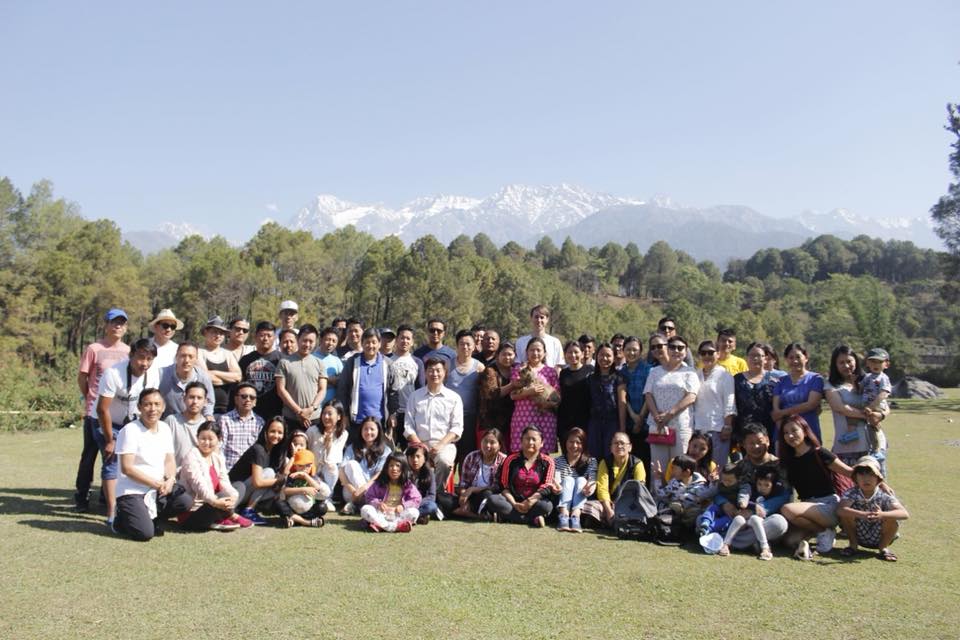
Team DIIR during the annual summer picnic in the woods of Mencha, Palampur. April 29, 2018

I have been informed this evening of Kashag’s approval of my resignation from my position as Information Secretary (equivalent) of Department of Information and International Relations effective January 11, 2019.

My resignation comes in light of few compelling circumstances that have made it imperative for me to resume my studies (PhD in Communication at the University of Massachusetts, Amherst). I will rejoin school this spring semester beginning January 22, 2019. Failing to do so might jeopardise my admission and funding from school, both of which have been on a continuous enrolment since September 2016.

As an academician himself, Sikyong/DIIR Kalon Dr Lobsang Sangay understands the importance of academic success and thus fully supports my decision to resume doctorate studies.

Having completed my original two-year commitment at DIIR (October 2016-October 2018) as a Special Appointee, I have had a great experience working with my much-respected colleague Secretary Sonam Norbu Dagpo la and my beloved staff at DIIR, under the leadership of DIIR Kalon Dr Lobsang Sangay. I have learnt many valuable lessons which I will cherish for a lifetime.

In my role as the Information Secretary at DIIR, I have performed to the best of my ability. I have also offered to extend my services to DIIR remotely as well as during my 2019 summer vacation.

As a Tibetan, I will continue to hold the cause of Tibet close to my heart and make every use of opportunity in academia and in life to further our collective cause. I am confident that completing my studies will enable me to contribute to the cause in a much bigger, impactful manner.

Sincerely,

Dhardon Sharling


My talk on Tibetan Non-Violent Resistance at the Symposium on Non-Violence held in Germany

The video of the talk can be viewed here


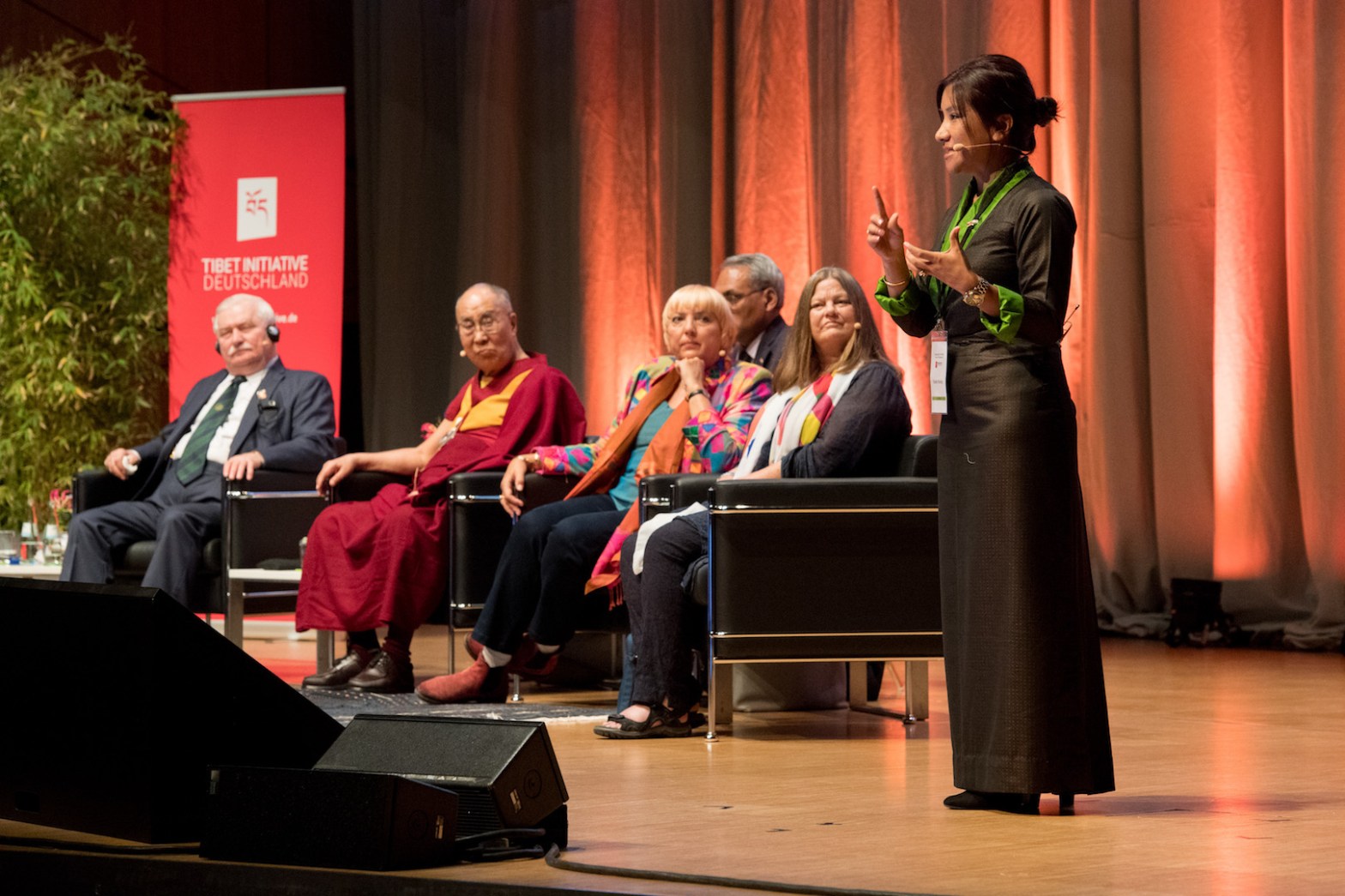
The talk was delivered on September 19 this year at Darmstad in the presence of His Holiness the Dalai Lama, Lech Welesa, former President of Poland and leader of Solidarnosch movement, Rebecca Johnson, founding president of International Campaign for abolition of nuclear weapons (ICAN), recipient of 2017 Nobel peace prize and Vice President of German Parliament Claudio Roth. The symposium on ‘Non-Violence’ was organised by Tibet Initiative Deutschland and Gandhen Phodrang Foundation.


Photo credit: Manuel Bauer

Tibet was an independent nation and was invaded by China in 1949.  Since then Tibet has remained under Chinese military occupation. In 1959 His Holiness the Dalai Lama was forced to escape into exile, to India with 80,000 Tibetans as Chinese authorities suppressed the first Tibetan national uprising. His Holiness and thousands of Tibetans arrived in India with ..literally… nothing. They overcame insurmountable challenges to build a refugee community.  Today the Central Tibetan Administration is a democratic institution based in Dharamsala, India that administers Tibetans in over 30 countries. It represents the Tibetan people’s aspirations in exile and in Tibet.

Tibet is of central importance for the Chinese Government. Their policies of control over Tibet emerge from economic and political interests of the Chinese leadership. China wants complete control over Tibet and the Tibetan people.
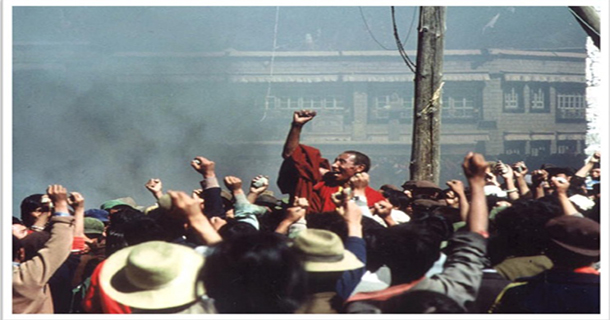
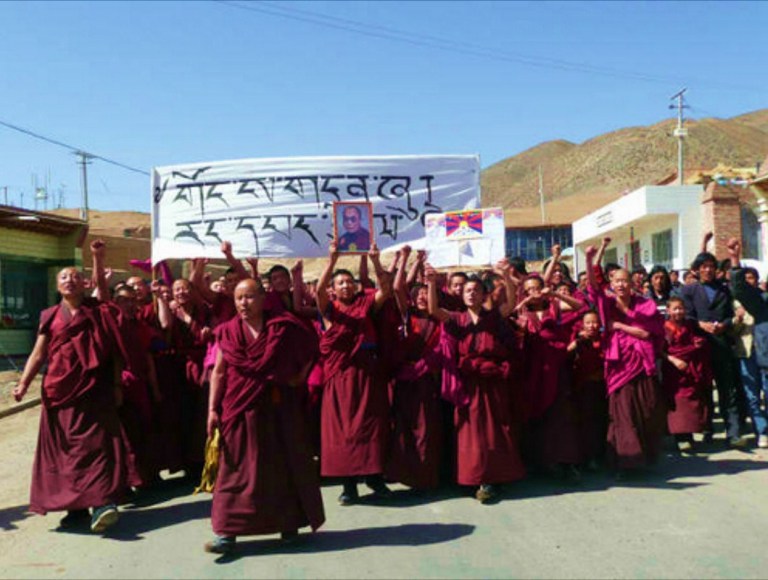
But Tibetans in Tibet have been resisting the ongoing brutal repression by the Chinese government with waves of uprisings –  in 1959, in the late 1980s and in 2008 – all of which have been met with military violence leaving thousands dead, tortured and persecuted. In the run-up to the 2008 Olympic Games in Beijing, Tibetans started protesting all over Tibet and it became a historic uprising. The following violent crackdown by China was a real turning point in the history of peaceful resistance in Tibet, and even though every single family had a victim of state violence, since this Uprising, there is a new, young and bold resistance in Tibet like never before.

Today, I want to tell you about one protest which I think shows clearly how strategic non-violent organizing is used by Tibetans in Tibet to make change.

-Chinese exploitation of natural resources in Tibet has led to protests across the country. More than 32 large-scale protests related to Chinese mining happened in Tibet since 2009.

—On 31 May 2016, around 2,000 local Tibetans from Amchok, in eastern Tibet, boldly challenged mining on their sacred mountain, Gong-nyong Lari. This was not only a question of disrespect to their culture and belief but this area is a nomadic area where people’s lives depend on the land and the water. The environmental damage caused by mining threatened these people’s very existence.

-The Chinese government brutally suppressed the peaceful gathering of local communities. The protestors were calling for “protection of the environment, protection of the sacred mountain and protection of the people.”

-Three Tibetans set themselves on fire at the same mining site in Amchok. Tsultrim Gyamtso cited in his last note unbearable misery caused by the mining on their sacred mountain as a reason for his sacrifice. Self-immolations started in Tibet in 2009 as a direct result of China’s crack down after the 2008 protests. The space for freedom of expression is drastically shrinking leading to Tibetans burning themselves to protest against the Chinese government.

Whether they are protesting in numbers or alone, singing songs, boycotting Chinese businesses or keeping their languages and identity  alive – Tibetan non-violent resistance continue to put China’s rule to test. Their actions remind everyone that nonviolence is not the same as passiveness.
Though much of the world might want to believe that Tibet is a lost cause and that there is no hope for Tibet given China’s rising dominance, I want to assure you all that this is not true. In this room, we have Golog Jigme with us. Earlier, I spoke about the Tibetan Uprising of 2008 that wrote history for non-violent resistance in Tibet. Golog Jigme was in Tibet in 2008, organizing side by side with our brothers and sisters.

Golog Jigme is a Tibetan filmmaker and a freedom fighter. Because of his involvement in the Tibetan freedom struggle, the Chinese government arrested him thrice. He stands here before you as someone who survived the torture by Chinese authorities and made a daring escape into the free world.  Many thought he had disappeared forever. But today he’s here with us! Since Golog Jigme escaped to exile in 2014, he has travelled the world crusading for the cause of Tibet. If Golog Jigme has not given up on Tibet, how can we?

Friends, if Tibetans in Tibet are finding new ways of resistance even after 60 years of oppression, if Tibetans in Tibet who risk arrest and death to carry out their struggle are not losing hope, we cannot either. We need to support them using our freedoms and democratic rights that we have here. When Tibetans are upholding non-violence as the core principle underpinning their struggle we need to support them with action from here in Germany.

Our friends who are here with us have also shown us that change is possible: Solidarnosc in Poland, Otpor in Serbia and ICAN for nuclear disarmament. Just like the Berlin Wall came down as you all know here in Germany: Non-violent resistance has the potential to create fundamental change.


For Tibetans in Tibet, His Holiness the Dalai Lama is the national symbol of hope and resistance / resilience and with the blessings of His Holiness the Dalai Lama and treading the path of non-violence, together we too can make a change for Tibet and for justice around the world. Join us!

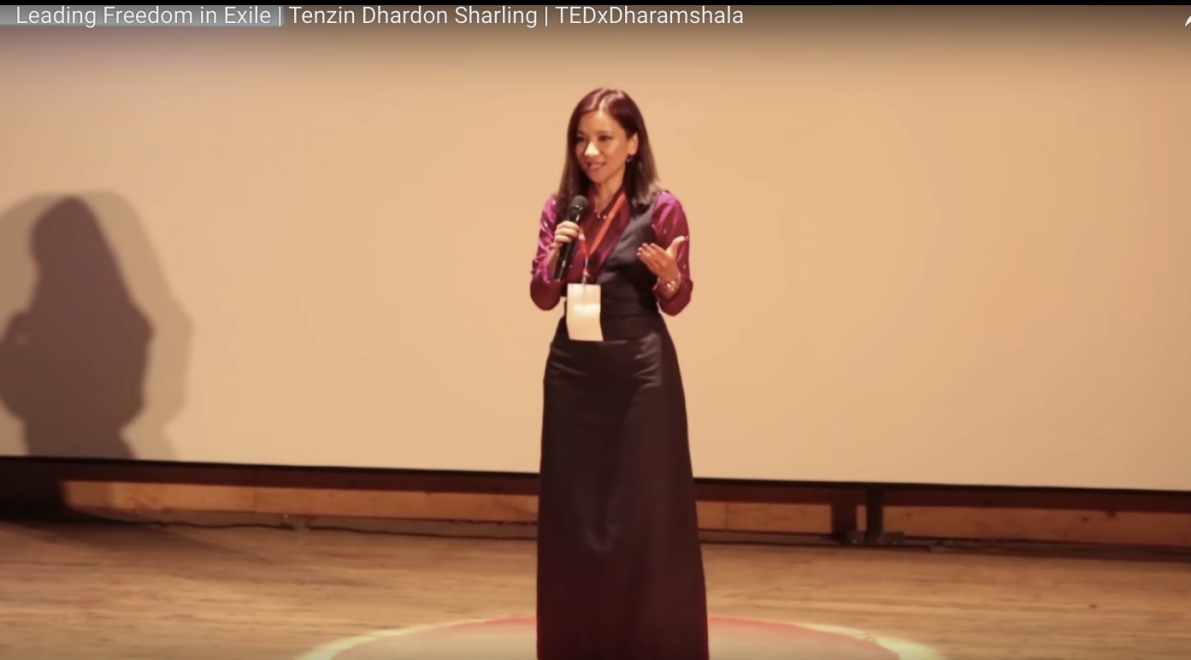
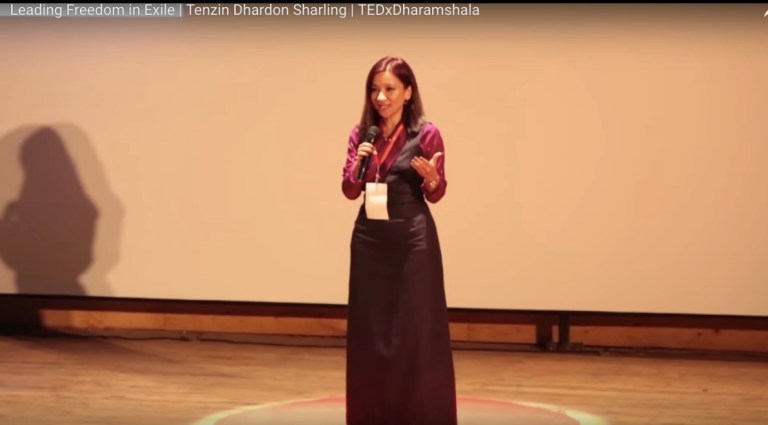
My TED x Talk on Leading Freedom in Exile

58 years ago, on March 31st, 1959, His Holiness, the Dalai Lama, reached India with approximately 80,000 Tibetans, who had known no home but their own. It was an escape from persecution and oppression from our adversary; Rehabilitation in India started with insurmountable challenge.

My father once told me a story that perfectly sums up the daily struggles of our people in a foreign land.

“When a group of Tibetans were stranded at a train station in North east India and they wanted to go to Delhi and then to Mussoorie because His Holiness at that point in time was residing in Mussoorie. It was for the first time, they were travelling in a train and devoid of tickets, they were looking to jump into the next train to Delhi. At the nick of the moment, they forget the name ‘Delhi’….. so one of the team leaders asked an Indian passerby at the pavement just two words ‘Dalai Lama….Kuuuuuoooooooo’ meaning train to Dalai Lama and the kind Indian got them onto the train to Delhi and from there to Dehradun.”

This is how we started…….

Acclimatization was a huge issue. Imagine… coming from the roof of the world to a hot and humid India. Indians in Delhi were surprised to see Tibetans clad in fur chupa (the Tibetan traditional dress) under Delhi’s hot May sun.

BUT , look at what we have achieved this far. We have a democracy in exile. The Central Tibetan Administration which many of you know as the de-factor Tibetan government in exile, headquartered here in Dharamsala, governs 46 settlements, 80 Schools, over 100 monastic institutes, scores of cultural centres in India, Nepal and Bhutan, 12 foreign missions covering all of the 5 continents. Tibetans are today in over 30 different countries, the general elections take place in 30 countries every five years.

The human elements of the exile administration: personal aspirations, challenges and triumphs reflect the large issues that the exile administration takes charge of, including international relations, welfare, education and sustenance of the settlements.

The CTA is one of the few entities that very effortlessly yet effectively engages in ‘Transnational governance,’ / digital governance. Very soon you will hear about ‘A Virtual Tibet.’ The possibilities for Tibetan people and our freedom struggle are limitless.

We have survived in exile as ‘the most successful’ refugee community in the world. So the question is how did a nation in exile could possibly grow to such levels in a span on 58 years, that many haven’t been able to do in complete independence? Well this because of three things: vision, leadership and the courage of conviction.

Under the leadership of His Holiness the Dalai Lama and his vision for a democratic Tibetan polity, we have a unique system of carrying out administrative responsibilities democratically but endowed with Buddhist spiritual values as core components.

Within months of arriving in exile, His Holiness’ vision—was to make education for Tibetan children his key mission… and he worked to realize his vision. One of my roles models is Jetsun Pema, the younger sister of the H.H Dalai Lama who set up the TCV Schools where I was educated at said,

“If a person has received an education that develops an inquiring mind, on his own he will begin to ask himself about his roots. Sometimes in the long run, that person will become even more involved in his culture and will contribute more.”

At TCV School we were taught to consider others before self and the importance of coming to learn but going to serve.

His Holiness’ vision was to see the future seeds of Tibet are educated with the right values- and become important contributing members of the global community.

The CTA is carrying forward this vision and now the Education ministry is incorporating secular ethics in the school curriculum, which is essentially, instilling the basic human values of love, compassion and altruism in the modern education system and the development of the head and the heart.

In his autobiography, His Holiness said that it was when he first stepped on the Indian soil, that he experienced real ‘freedom,’ It was in exile that he found freedom, led freedom and the quest for freedom has set the foundations for Central Tibetan Administration.

To lead freedom, one must first understand freedom. In trying to decipher what freedom means, we have much to learn from the Jewish experience. It is said that the symbol of slavery precedes symbols of freedom because only to someone who experienced slavery, will freedom taste better. So at the Jewish Passover, they eat the bread which symbolizes affliction first, then the bitter herbs that symbolize suffering/slavery and finally the wine which symbolizes freedom/liberation.

Therefore, I always believed that freedom is not just the absence of oppression, but the presence of purpose, a clarity in vision and mission to achieving that purpose. The Central Tibetan Administration (CTA) is a living testament to this belief I held onto all my life. It is driven by a vision and a purpose- to restore freedom inside Tibet and ensure the return of His Holiness the Dalai Lam to Tibet.

To achieve its vision and goals, CTA follows the Middle Way Approach. If you ask me what the middle way approach is about—, well, it has many layers and nuances to it. It is an ideology, a philosophy, a guiding princinple, an approach and a strategy For the Tibetans MWA is based on the principles of non-violence, truth and reconciliation, one that seeks to engage with the People’s Republic of China through dialogue and enable Tibetans to preserve their culture, language, environment, identity and religion. At the heart of this approach is the steadfast resilience of Tibetans inside Tibet, who are both the driver and the amplifier of the Tibet movement.

As the nerve centre of the Tibet Freedom struggle, the CTA is committed to not only uniting all Tibetans but is the custodian of their cultural identity and the harbinger of hope for every Tibetan.

It is said that the worst part of exile is to forget that you are in exile. CTA is a reiteration and expression of the Tibetan people’s desire to be free. We are a living proof that we cherish freedom and long for it. So this profound predicament that exists today of the Tibetan people in my view shows that despite the current darkness, pressures are building for change and the prospects are brighter for new beginnings for the people of Tibet. It is hope that steer us into the future.

I was in Taiwan earlier this week and while doing an interview with Radio International Taiwan, the host asked me ‘what does the Dalai Lama mean to you,’ and my response, in just 1 line was that His Holiness is my conscience and sets the moral barometer for everything I do and commit to. People in Tibet refer to him as the sun—the unifying figure—an assertion of the Tibetan cultural identity.

The four commitments of His Holiness the Dalai Lama: 1) Promotion of Human values 2) Religious Harmony 3) Preservation of Tibet’s Environment, Identity, Culture and Religion 4) Promotion of Secular Ethics and revival of the Ancient Indian Wisdom, these commitments define his vision and mission in life.

To the rest of us, His Holiness is someone whose words train the human mind, whose smile heals the human heart and whose actions transform human lives.

The year 2011 was a watershed year for Tibetans. It was the year in which His Holiness the Dalai Lama announced his decision to devolve his political leadership. All of us panicked and even urged him to rescind his decision. We lacked the courage and the conviction to see the strength in his vision. But like how a father would do to his child, His Holiness made us stand on our feet.

Today under the leadership of a democratically elected President/Sikyong Dr Lobsang Sangay, the CTA now multifariously spearheads its quest for freedom with the hope to finding a resolution through dialogue with China and at the same time preparing a clear long-term vision should it continuously have to remain in exile. Of this quest and aspiration gave birth to the ‘Five-Fifty Vision’ of CTA.

The CTA’s Five-Fifty Vision is premised on His Holiness the Dalai Lama’s advice to ‘hope for the best and prepare for the worst.’ It seeks to restore freedom inside Tibet within the five-year tenure of the political leadership, through the Middle Way Approach (MWA). To restore freedom in Tibet, the foundations of freedom in exile Tibet should sustain, strengthen and succeed for fifty years, if needed. Therefore this vision is a win-win strategy.

In October this year, the Five-Fifty Forum was convened. The gathering of scholars, experts, policy makers, strategists, retired Tibetan officials and young Tibetan leaders met to discuss Tibet’s future. This is done on the strength of having survived and succeeded in exile for over half-a-century and on the basis of having a long history as an independent nation.

I can vouch for the fact that the purpose of a nation should not be based just in the present but the future as well. It is said that where there is no vision, there the people perish. The environmental crisis that stands to threaten humanity is also an example of our lack of vision. As a matter of fact, even the terrorism we see globally find its roots in the greed of the few and lack of a far sighted vision.

The Tibetan freedom struggle is guided by a vision. This vision guides all of our actions—at both strategic and tactical level. This vision conveys the message loud and clear that we will continue with our struggle until freedom is restored in Tibet.

Personally, as a Tibetan I feel truly privileged and more privileged that I work for CTA and am able to represent my nation’s struggle for freedom and justice. But my personal and professional life has not been one without its shares of struggles. One approach that has always guided me—is to not look at problems as problems but rather as challenges and every time you overcome a challenge, there is a sense of achievement. After all, what is life without challenges, without the ups and downs……you will be at the dead-end. Thanks to the challenges and my ability to overcome them…today I am standing in front of all of you. I truly believe—you are your life’s architect and author—at any point in time you could turn back and say…hey this is not how the story is going to end.   When one door-closes, the other opens.

The struggle that our country is going through now is just one such challenge that we need to overcome. Tibet represents a unique and precious spiritual and cultural tradition whose values of non-violence, mutual respect, and compassion are an important and special part of the heritage of humankind.

As much as we might try, humans are social beings who need one another for their survival and existence. While most countries are talking about keeping out other nations, His Holiness and the CTA recognise the importance of maintaining friendly relations with others and considers a mutually beneficial solution to resolving problems and differences.

The Tibetan approach to its freedom struggle can be a powerful inspiration and example to others around the globe as an alternative / antidote to the cruelty of war, violence, terrorism and extreme nationalism.

One pertinent question that every Tibetan gets asked is What after the Dalai Lama…? Will Tibet be a lost cause?’ My response to these questions is ‘His Holiness the Dalai Lama is not just an individual, but he is an idea…he is a phenomena and will live for ever. He is eternal, immortal and indelible……Every 6 million Tibetan and the billions of his followers will carry forward his vision and this will make him and his commitments live forever and to inspire possibilities.

The CTA under the blessings of His Holiness the Dalai Lama is today the mascot and symbol of Tibetan people’s quest and struggle for freedom. The very story of CTA, the story of hope and resilience as it continues to unfold, is a living proof that even in direst of situations and in most challenging times, leading freedom in exile is a possible reality and it is this freedom that we hope to restore and lead in our homeland and for our people and that day, I believe is not very far.

Finally, I would like to recount what a democracy activist from Northern Eretria (Africa) who I met at a ‘Initiatives for Change summit’ years…told me “ If Tibet succeeds, the world succeeds.”

And truly …the world has much to benefit from Tibet’s success story.

Watch the video on youtube  

The talk was part of TED x Dharasmala held on November 12, 2017

CHUPA POWER

Clad in dark grey Chupa and off-white Wunju,

Donning the Tibetan National Flag pin on my collar,

I walk hurriedly down the lane of Delhi’s busy Khan Market,

Bustling with activities- human and commercial under the late evening sky,

Delhities find respite after the late evening showers,

Running because I am a few minutes late for my next meeting,

Amidst the jarring cacophony of human conversations and cars honking,

I hear someone utter the Tibetan word ‘Tashi Delek’,

Albeit echoed in an Indian accent,

As I turned around to see if I bumped into an old acquaintance,

To my sheer surprise,

I see a young Indian man in his late 20’s walk past me,

Affording a warm smile implying to wish me,

In the most chivalrous yet respectable manner,

Not only did my Chupa assert my cultural identity,

My chupa earned me recognition amidst a sea of people,

My Chupa got in me a sense of gratification,

My Chupa made me feel a sense of belonging,

My Chupa showed me the love and respect Indians have for Tibetans,

My chupa instilled in me a sense of pride in being a Tibetan Woman,

My Chupa, my Pride.

Reproductive governance in the Tibetan community in exile- Discrepancies and digressions

This piece originally appeared in December 2015 edition of hystericalfeminisms.com

http://www.hystericalfeminisms.com/reproductive-governance-in-the-tibetan-community-in-exile-discrepancies-and-digressions/

Introduction – Reproductive Governance

This paper analyzes reproductive governance in public policy and how it applies to the exile Tibetan discourse surrounding women’s reproductive responsibilities. Drawing heavily on Lynn Morgan and Elizabeth Robert’s ‘Reproductive Governance in Latin America’ (2012), this study explores how political rationalities, social responsibilities, and ethical assumptions frame the domain of reproductive discourse in the Tibetan exile diaspora. This study also analyzes how the reproductive governance in Tibetan exile community faces the risk of being formulated as a public policy and how the discourse is fraught with discrepancies and digressions that need to be ironed out.

According to Morgan and Roberts, the concept of reproductive governance is “mechanisms through which different historical configurations of actors—such as state, religious, and international financial institutions, NGOs, and social movements—use legislative controls, economic inducements, moral injunctions, direct coercion, and ethical incitements to produce, monitor and control reproductive behaviors and population practices” (p.1).

The authors seek to apply the concept of reproductive governance to other contexts in order to understand shifting political rationalities within the domain of reproduction. I found their explanation of “reproductive discourses as being increasingly framed through morality and contestations over ‘rights’, where rights-bearing citizens are pitted against each other in claiming reproductive, sexual, indigenous, and natural rights, as well as the ‘right to life’ of the unborn” interesting and highly relevant to my study on reproductive discourse in the exile Tibetan community.

Morgan and Rogan’s work opened a whole new terrain for me to use ‘reproductive governance’ as a framework to understand the socio-economic and political beliefs and expectations shaping the reproductive debate in the Tibetan exile diaspora. The authors point out how “overpopulation was the main target of reproductive governance in Cold War Latin America” despite lacking much “evidence that Latin America as a whole had a population problem.” The authors also explain that although the effects of reproductive policies are often analyzed and approached as national phenomena, it is clear that global economic and social movements also have an impact on population and reproduction patterns. In a similar vein, the exile Tibetan discourse necessarily involves an examination of socio-political factors: China’s birth control policies, imposed on both Tibet-based and exile Tibetans, hinder Tibet’s culture, and identity from thriving – that which forms the foundation of the reproductive debate.

Scholarship on reproductive governance point towards how governance regulates the reproduction debate, decision and dictum. It also explains that the governance can be mandated by either the state, religious institutions or figures, and authorities, civil society or individual mentality. This paper looks at how political figures and social actors in the exile Tibetan community govern the reproduction debate in the exile and how it faces the risk of settling into the framework of public policy, accompanied by the concern surrounding the dwindling population in exile, . Furthermore, this paper examines the implications of the exile reproductive discourse on feminist studies, and whether the reproductive rights rhetoric is the solution to the current state of reproductive governance in Tibet, fraught with discrepancies and digressions.


Reproductive governance in exile—heading towards a policy formulation?

On October 15, 2008, the Kashag outlined the policy while underscoring the need to strengthen women’s role in the administrative and political domains of the democratic Tibetan community. On the 48th anniversary of Tibetan democracy in exile, the Kashag (Cabinet) of the Central Tibetan Administration (CTA) announced an eight-point policy to empower women in exile.

While this was widely considered a milestone achievement for Tibetan women and a huge step on the part of the CTA, the preamble of the policy disclosed a flawed depiction of gender status in Tibetan history. It stated that “no gender discrimination of any kind have taken place in the history of Tibet.” This gave rise to critique from Tibetan feminists, Tibetan intellectual society, and Western supporters as well. The eight-point policy catered to the nuns, women’s leadership at the grassroots and institutional level, women’s health and childcare, women and sports, among other empowerment initiatives.

Notably, however, the sixth policy read: “The new policy will lay special consideration on the health of mother and child in order to develop a future posterity with good morals and facilitate a steady growth of population. Moreover, special workshops and necessary facilities will be given to those women who have formed their new families to help them become good mothers.” While written with the best intention to protect the ‘mother and childcare’, the statement offers a worrying implication by advocating a framework for reproductive governance. This policy alluded to the need for women to reproduce “and facilitate a steady growth of population.” The policy also presents “good morals” as a prerequisite for mothers, and “good mothers” and bad fathers as the prerogative.

In 2012, when the spate of self-immolation protests in Tibet escalated, exacerbating the already tragic political situation in Tibet, the Tibetan government in exile, under the provision of Article 59 of the Charter of Tibetans in Exile, called for a Special General Meeting of Tibetans in September 2012. 432 delegates from 26 countries took part in the meeting to discuss and strategize an action plan for the Tibetan government in exile and for exile Tibetans to address and resolve the Tibetan political crisis.

The meeting adopted 32 recommendations and a list of campaign actions, finalized with the consent of the overwhelming majority of the participants. The 16th recommendation read: “That there is a real problem of the Tibetan population being too small for the purposes of carrying on the struggle both from the current and from the long term perspectives is an obvious fact. There is therefore a need to increase the birth and nurturing of Tibetan children and the Central Tibetan Administration should give special consideration to caring for families having three or more children.”

Though it does come as a surprise that a political meeting to discuss the crisis in Tibet sees a solution in stepping up the child breeding dynamics, what is more alarming is the fact that the recommendation is implemented with immediate effect. The Department of Health of CTA annually allots over six million Indian rupees for the ‘mother and child care’ program catering to the reproductive health of the mother and child. For many years, the CTA has been considering offering financial incentives and additional support to encourage exile Tibetan families to have more than three children. Beginning in 2014, the scheme was implemented and made available for families in India, Nepal and Bhutan with four or more children. The government offers support in the form of scholarships, health benefits, and rewards.

During the annual budget session of the Tibetan Parliament held in March 2014, I raised a question to the Health Minister, asking him if the ‘need to reproduce more number of children’ is a policy of the department of health of CTA. The minister responded, “It is not a policy but a guideline and in a stricter sense, a request.” Last year, the political leader of the Tibetan government in exile, Dr. Lobsang Sangay, the 43-year-old Harvard graduate, was quoted in an interview saying, “Tibetan women are encouraged to produce more children….It is important to have Tibetans in numbers.”


Population in exile—the concern?

One of the visible and pressing reasons why an increased population in exile is seen as a social and political imperative is because of the dwindling Tibetan population in Tibet and the stagnant growth rate in the exile population. On April 12, 2009, the Planning Commission of CTA conducted a worldwide survey of the Tibetan population in diaspora. The report, titled “Demographic Survey of Tibetans in Exile-2009”, states that the survey found the total population of Tibetans outside of Tibet, as of 12 April 2009, stood at 127,935, constituting 70,556 males and 57,379 females (in comparison, a population of 111,020 recorded during the 1998 survey. The report mentioned that the sex ratio for Tibetan population in exile is 798 females for every 1000 males, which is a growth of 6 points over 792 recorded in 1998,

The survey also showed some aspects, particularly regarding the population growth rates, which, according to the CTA, could mark a “worrying trend for the exile Tibetan community. The annual growth rates, which were estimated to be 2.8 percent for the last 30 years (1969-1999), has dropped to 1.96 percent in 2009. The survey also showed that the total fertility rates, based on “own-child method”, which, for the period prior to 1998, was estimated to be as high as 4.9 during 1987-89, having gone down to 1.18 in 2009; thus, showing a 3.65 total decline in the fertility level in 2009.

The survey said two major factors – namely, “growth in literacy rate among the young child bearing Tibetan women and rise in contraceptive prevalence” – might have caused the fertility transition in the Tibetan population. The survey opined that “while more educated women take a longer time in building their careers that delays their age at marriage resulting in fewer children or forgoing having them altogether, the contraceptive prevalence has risen substantially from only 10 percent among the married women in 1980’s to 95 percent in 2001.” The survey results expressed concern over the decline in exile population. This does leave room for worry as the Tibet-based population remains stagnant and threatened.

The decline in population growth rate and fertility rate in exile are exacerbated by the socio-political conditions back home in Tibet, where the Chinese government’s policy is posing serious threats to Tibetan demographics; thus, raising the onus on the Tibetan community in exile to compensate for the loss of population, or to fill the gaps by producing more children.


Implications of the reproductive discourse on feminist studies

Examining the reproductive governance debate and rationale in the exile Tibetan discourse, we can see certain themes like women and nationalism, ethics and politics, and the right rhetoric, which collectively reflect debates among feminist scholars, such as Ethne Lubhied, Alex Buttler, Morgan and Roberts.

1) Women and nationalism: It can be understood that by producing children, Tibetan women in exile are seen as ‘reproducing nationhood.’ Women who produce more children are thus seen as fulfilling their nationalistic duty. Butler’s discussion of ‘Feminism, Nationalism, and Exiled Tibetan Women’ (2003) looks at the overlaps and tensions between nationalism and feminism, in exile.

Of the very few literary feminist works on ‘women and nationalism,’ Anthias and Yuval-Davis (1989), postulate that one of the major ways in which women have participated in the national process is as “biological reproducers of members of ethnic collectivities” (p. 7). The Tibetan political struggle weighs heavily on the reproductive assumptions, expectations and governance. Tibetan Women are seen in roles such as guardians of national culture, family traditions and breeding for political goals.

2) Ethics and politics: is it the political reason for the ethical judgment or it just the politics of ethics? In the Tibetan context, political rationalities determine and influence women’s reproductive freedoms, a woman’s right to be able to determine – without coercion – the spacing and number of children.  The exile Tibetan reproductive discourse infuses ethical and moral dimensions to the issue as women refusing to marry and failing to produce more children are seen as being un-nationalistic, and uncaring about Tibetan demographics. The social dictum for a women to reproduce now sounds moralizing and has become a condescending organizing principle in everyday exile discourse at all levels: individual, social and institutional.

3) The right to life rhetoric: Butler (2002) makes a “linkage between Western pro-life attitudes and those of Tibetan women.” Tibetans have a pro-life attitude and as Buddhists would vouch for the “right to life of the unborn.” But strangely, the same approach would be lacking in the ‘right to reproductive health of women’, including an abortion. Heavily influenced by Buddhist pro-life beliefs and propagation, Tibetans see abortion as a taboo and sin, and is thus considered ‘un-Buddhist and un-Tibetan.’ In a culture where women are criticized and censured for not marrying, and for not producing more than three children, one can imagine the kind of censure women who chose to abort would face.


Is Reproductive Rights rhetoric—the solution?

In the exile Tibetan scenario, the utilization of the reproductive rights rhetoric seems to offer the resolution to reduce the contradiction between reproductive choice for women in Tibet and in exile.

A reproductive rights is the basic right of all couples and individuals to decide freely and responsibly the number, spacing and timing of their children. The right of women to make decisions concerning reproduction should be free of discrimination, coercion and violence. It is the women herself who should have the right to her own body and have the freedom to make her own reproductive choices. Any state or civil or moral interference in a women’s reproductive decision is a violation of her rights—be it China’s birth control policies in Tibet or exile government’s guidelines or any form of moral and social pressure on women to increase population in exile.


Conclusion

Reproductive governance among exile Tibetans is practiced widely and faces the dangers of becoming an established part of the policy framework. It is a flagging issue thwarting any discourse on gender and women’s empowerment in the Tibetan context. However, the collective notions of the impetus of population control in Tibet and the need to fill the gap by putting the obligation on women in exile to reproduce more can give way to a policy formulation. Any individual with commonsense and basic knowledge needs to realize that putting pressure on the “57,379 women in exile” to produce more children cannot rationally justify China’s birth control policies in Tibet.

Though the need to reproduce is a pressing issue and women in exile face the pressure to reproduce to fulfill their patriotic duty, it is the women’s prerogative and her right to her body that ultimately counts and matters. As strange as it may sound, I am inclined to juxtapose the two taglines—‘Women in Tibet have the right to reproduce and women in exile have the right not to reproduce.’ To put it more succinctly or sensibly, I would propose a cohesive tagline: “Both women in Tibet and in exile should be entitled to their own reproductive rights, and this is a legal right enshrined in ‘Article 1 of the UN Charter’ that needs to be respected and upheld.”


References

Butler, A. (2003). Feminism, Nationalism, and Exiled Tibetan Women. Kali for Women, New Delhi.

Demographic Survey of Tibetans in Exile (2009). Planning Commission, Central Tibetan Administration.

Davis and Anthias, F. (1989). Women-Nation-Sate. The Macmillan Press, Houndsmills, Basingstoke, Hampshire.

Luibhéid, Eithne (2013) Pregnant on Arrival: Making the Illegal Immigrant. Minneapolis: University of Minnesota Press.

Morgan, L. and Roberts, E. F.S. (2012). Reproductive Governance in Latin America. Anthropology and Medicine 19:2

Tears of Silence (2009), Tibetan Women’s Association Publication, Dharamsala, India.

http://tibet.net/2012/11/action-plan-and-resolution-of-special-meeting-on-tibet/

http://www.tibetjustice.org/reports/women/iv.html

http://www.un.org/en/documents/charter/chapter1.shtml