Rethink Sino-Tibet policy for India’s survival, conference panelists say

This article originally appeared in Phayul.com on December 20, 2010.

http://www.phayul.com/news/article.aspx?id=28791


The conference on ‘Rethinking India’s Sino-Tibet’ policy affirmed that its time India look them (China) in the eye on Tibet issue.


New Delhi- The world’s largest democracy may be basking in the incontrovertible feat achieved in its 63 years of independence: its transition from a third-world developing country to its pioneering presence in the Non-Aligned Movement and also a super power in the reckoning, however when it comes to dealing with China, India’s Sino-Tibet policy remains apocryphal and a misfit in India’s otherwise paragon of virtue image.

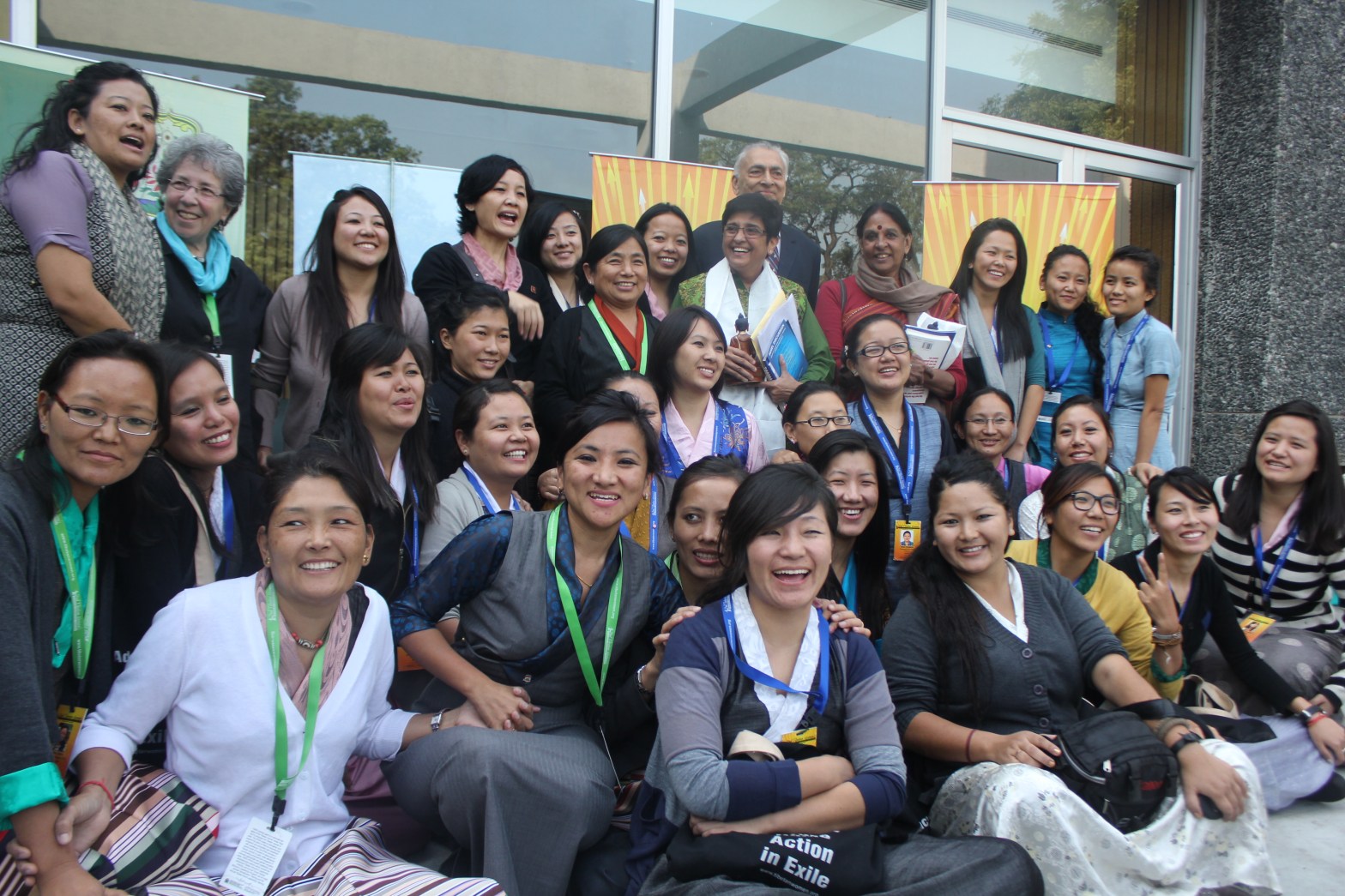
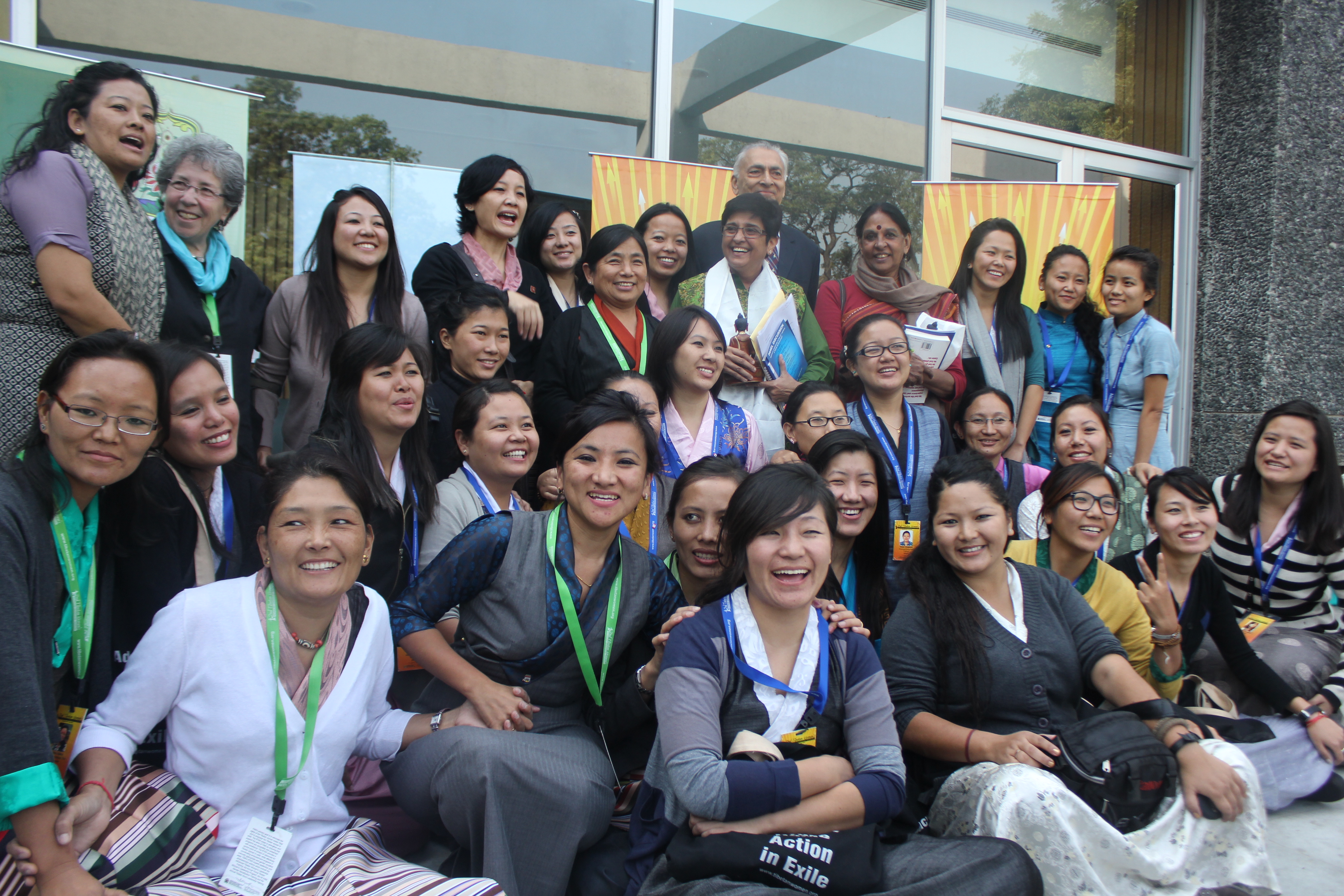
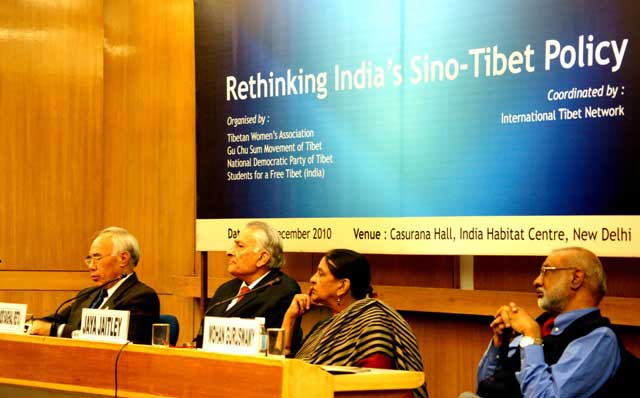
Amidst reports of a staggering 60-billion-dollar business deal between the two Asian giants in the light of the three-day India visit by the Chinese premier Wen Jiabao and other trade deals galore, there is one area where India has faltered and failed miserably and that is in containing the ‘Sino-Tibet’ policy. Yes, this was the consensus emanating out of the December 15 conference: ‘Rethinking India’s Sino-Tibet policy’ organized by four Tibetan Non Governmental Organizations (Tibetan Women’s Association, Gu Chu Sum Movement of Tibet, Students for a Free Tibet, India and the National Democratic Party of Tibet) and held at the Casuarina hall, India Habitat Centre on the first day of India visit by Chinese premier Wen Jiabao.


The conference that took stock of complex − India-Tibet-China − triangular relations was chaired by Major General Vinod Saighal (Retd), the Executive Director of Eco Monitors Society (EMS) and author of the internationally acclaimed books including ‘Third Millennium Equipoise’ and‘Dealing with Global Terrorism: The Way Forward,’ Three keynote speakers addressed the conference; Jaya Jaitley, former president of Samata Party and a social activist, Tempa Tsering, minister (Kalon), Tibetan Government in Exile and the New Delhi representative of His Holiness the Dalai Lama and Mohan Guruswamy, the Chairman and founder of Centre for Policy Alternatives and author of ‘Chasing the Dragon: Will India Catch Up with China?’

Coordinated by International Tibet Network, the conference saw an interesting audience composition; representations from India’s intellectual, policy-making, political and media quarters and few Tibetan activists.

At a time when India is in compelling situations created by China’s tremendous political, military, economical and geopolitical pressures on India, the speakers expressed scepticism in commenting on India’s acquiescence to China on the Tibet issue and demanded a stronger spine in India’s position.

History;
All the four speakers emphasized that historically China never was India’s neighbour and that Tibet was India’s neighbour and that it was Tibet who’s had relations with China albeit the equation kept vacillating from ‘being cordial to fighting wars.’

The Indian speakers lamented that there is no point castigating history as the inevitable fact of the matter is that ‘when China occupied Tibet, India could do nothing.’ “Inundated with the newly found independence and weakened by the partition, India was not in a position to take a realistic position on Tibet” reasoned Guruswamy. But it could be deciphered from the discussion that as the political landscape of the Himalayan region is beginning to unravel in the 21st century, the past history is a good indicator in discerning patterns of change in the future.

Border;
The conference stressed on the burning border rows between the two neighbours which is primarily because of the fact that from being an erstwhile effective buffer zone between China and India, Tibet’s 4000 km border now is place to world’s largest concentration of armed forces and military apparatus.

Jaya admonished the Indian government for skirting the issue of border security with China. “The ministry of external affairs is complacent in its posture where India has succumbed to the military dictatorship of its brutal neighbour” she said. Guruswamy added that the Indo-Chinese border is amorphous because ‘with Pakistan, India has a defined Line of Control which is essentially missing with China.”

Communist ideology;
Both Jaya and Guruswamy attributed the Asian fantasy with the rampant Communist insurgency in the early 1950’s as one reason why Asia failed to rebuke the Chinese occupation of Tibet. “Communism was converting Asia and India’s then Prime Minister Jawaharlal Nehru himself was taken in by the soviet experiment” recalled Guruswamy. “People treated it as reform and change coming to Tibet,”

Jaya admitted that the communist thinking continues to dominate the Indian intellectual and foreign policy thinking. “When I was in the government, we realized that the policies of government were not run on issues of security but based on meekness and strange ideas of diplomacy which were dominated by communist thinking,” she recalled.

China’s greed;
While the Indian speakers labelled the encroachment into and the consequent annexure of Tibet by China as a murder, Kalon Tempa Tsering identified China’s greed for land and power. In recalling His Holiness the Dalai Lama’s hope for a genuine relationship between India and China, he commented “while genuine relation must be based on trust, China’s greed for territory, its insatiable taste for more land and its ambition to dominate and subjugate others and its unyielding stubbornness to hold to one-party rule are definitely not the basis for building trust and mutual confidence.” Kalon Tempa Tsering further added that ‘China’s never-ending rows with most of its neighbours are illustrative of its desires and designs’. He indicated that India’s restrained relations with its neighbours; Pakistan, Burma and Nepal, who, historically share a close cultural affinity with India, traces to the coerced instigation and incitement from China.

Commenting on the Chinese ambassador to India, H.E. Zhang Yan’s rhetoric remark that ‘the relationship between India and China is very fragile,’ Guruswamy berated ‘anything made of China is fragile.’

The panel discussion not only provided an in-depth overview of India’s 60 year old policy on Tibet, but identified the avenues and areas for India to make amends and do the thinkable; Re-Thinking.

Environment; The discussion dwelled on the one vital issue of Tibet that concerns India more than Tibet which is the massive rampage perpetrated on Asia’s water tower. The speakers ascribed Tibet’s environment to being crucial for the survival issue of India and the downstream nations. “China is building dams on the Brahmaputra and if India doesn’t voice out against this then the whole of north-eastern region of India could one day become a desert if India is deprived of the water flowing from Tibet’s glaciers” warned Jaya. She further added that ‘it is in India’s interest to see that Tibet’s grazing lands are protected and that Tibet’s waters are preserved.’

His Holiness the Dalai Lama;
The speakers enunciated on the dire need for a more realistic position by the Indian government on His Holiness the Dalai Lama. Kalon Tempa Tsering reiterated His Holiness’s proposal for a peaceful resolution on Tibet through the middle way approach. The Indian speakers conveyed that India has an imperative role to play in asking China to stop abusing him and in pressing the Chinese leadership to talk with him. Jaya complained that it is in ‘India’s acquiescence to have two yardsticks in dealing with His Holiness only as a spiritual head.’ She stressed that like every other leader, ‘His Holiness must be given the freedom to speak the exact words.’ “You always cannot have a man like the Dalai Lama to expect us to read between the lines,” she reasoned. Guruswamy stressed that India must strategize and prepare for a post Dalai Lama era. “Like the two Panchen Lamas it is foreseeable that there will be two Dalai Lamas”.

India’s identity;
The speakers bemoaned that ‘India is humiliated time and again by its ruthless neighbour and that there seems to be a mutual agreement that India is weak in its knees and that it has conceded to the Chinese atrocities.’ “When it comes to tackling the Tibet issue, we cannot take the backseat and be neck-deep in our own little pond, worried about our inner politics,” Jaya affirmed.

Jaya vehemently remarked that ‘India is negligent because of its sluggish bureaucracy and because it is intimated by the big and powerful neighbour.’ “This is one reason why China disrespects India” she said. Substantiating her point, Kalon Tempa Tsering advised that the Indian stand on China should be smarter considering ‘China’s respect for strength and power’.

On the issue of Chinese stapled visas issued to applicants from Jammu and Kashmir, Guruswamy gave a no holds barred comment that there is room for India for a tit-for-tat policy and suggested that India could start issuing stapled visas to several nationalities under the Chinese occupation. Commenting on the India’s foreign minister S.M Krishna’s recent remark -‘Kashmir is to India what Tibet and Taiwan are to China,’ Guruswamy’s deridingly spiteful remark ‘who will believe a man who hides his truth by wearing a wig?’ drew pearls of laughter from the audience.

The conference highlighted that it’s time for India to shed its elephantine firmness on its Sino-Tibet policy and that India can now no longer prevaricate on the Tibet issue which has hitherto been the mantra. The discussion underscored that it is time for India to ‘look them (China) in the eye’ and that there could be no better card then the Tibet card and no better opportunity then during the lifetime of His Holiness the Dalai Lama. The discussion sternly stressed that tackling the Tibet issue is largely in India’s interest than in the Tibetan interest and that the perpetuating idling position of India will be ‘detrimental for the future of India—for its economy, security, ecology and for its very survival.’ The conference concluded that ‘a revised, stronger and strategic India’s Sino-Tibet policy will bolster India’s survival of its self respect and significantly its sense as a nation.’
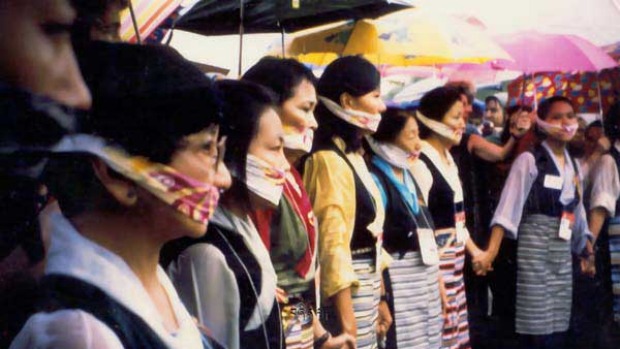
Tibetan Women: Devotedly Defiant

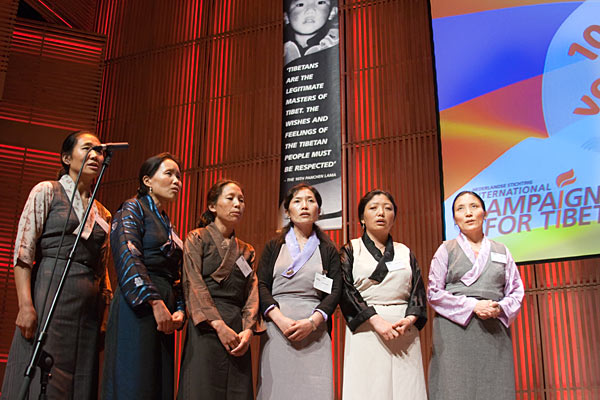
Beijing, September 1995: nine exiled Tibetan women staged a silent protest at the United Nations World Conference on Women held in Beijing.

The essay titled ‘Tibetan Women: Devotedly Defiant’ featured in the book  ‘A Force Such As the World Has Never Known,’ which is an anthology of essays by 30 women authors, published in November 2013 by Inanna Publications and Education Inc, 2013, Canada.  

Chapter Ten

 Image Image

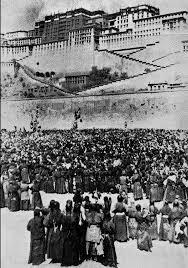
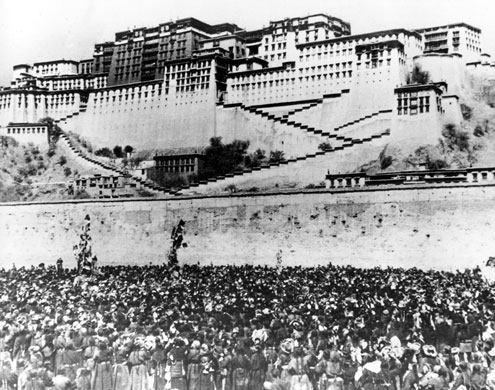
Lhasa, March 12, 1959:  Tibetan women gather in thousands in front of the Potala Palace to protect His Holiness the Dalai Lama.


 Tibetan Women: Devotedly Defiant

 Tenzin Dhardon Sharling, TIBET/INDIA


 Early years of political struggle

In the history of human struggle, women have played a significant role. While the actions of a few extraordinary women may stand out, the efforts of ordinary women remain in the background. Early Tibetan history does not boast of heroines, and even in the early twentieth century, there was no tradition of women political leaders or government officials, and no vision that things would change with modern education. But when the fate of the nation and its people reached a critical juncture in 1959, Tibetan women united as one and conjoined the movement. Thus, for the first time in Tibetan history, women’s voices became visibly pertinent.

 On March 12, 1959, Lhasa, Tibet’s capital and seat of His Holiness the Dalai Lama, was filled with the sounds of feet stamping the pavement and shouted pleas for freedom: with hands raised high in the air, Tibetan women stood united against the Chinese communist regime’s unlawful occupation of their nation. An estimated 15,000 unarmed Tibetan women took to the streets of Lhasa to oppose the violent Chinese occupation of their country. As the defiant crowd grew in number, a few women spontaneously took charge. One of them was Ghurteng Kunsang who stepped forward and spoke out forcefully urging that ‘Tibet should fight back not with violence, but with peace and compassion in the effort to force the Chinese back to their own land.’[i] This day marked the first active, women-led non-violent protest against the Chinese occupation and laid the foundation for peaceful resistance in Tibetan history.

Following the historic uprising, women took part in successive protests and resistance against the repressive Chinese regime. The Chinese military responded brutally, opening fire upon the crowds. Many of the women who stood up on that epic day sacrificed their lives in pursuit of freedom. Those that escaped with their lives found themselves imprisoned and subject to inhuman torture. The surviving, exiled elders are the last generation of women left to tell the story of the Women’s Uprising, and to transmit their cultural legacy. More than half-century after Tibet’s national uprisings, reality in Tibet remains smoke-screened by Chinese Government. News and knowledge make it through a veil of repression only through the efforts of courageous men and women who risk their lives to make their stories heard.

In the early decades of the last century, there was no tradition of Tibetan women standing shoulder-to-shoulder with men in public affairs. As the Tibetan adage of the time pronounced, “the mother is the precious jewel-at-home, the father the external fencing.” In a period when women remained totally home-bound to care for the family, cocooned thus in a corner of the walls of time, the communist Chinese occupiers created havoc; women stood against this repressive regime and to this day have, with utmost resilience, courage, and dedication, driven the movement forward.

Women inside Tibet remain defiant

 While Tibetan women continue to be the victims of the repressive policies of the Chinese government—systematic oppression, coercion, and sadistic state-sanctioned violence, —the spirit of Tibetan Women refuses to rest. As the official website of the Office of Tibet, New York suggests, “the present Chinese policy, a combination of demographic and economic manipulation, and discrimination, aims to suppress the Tibetan issue by changing the very character and the identity of Tibet and its people.” [ii]

For those remaining in occupied Tibet, the struggle continued, often with dire consequences. Women, in time of crisis, have stepped forward and assumed the mantle of political leadership. Nun Thinley Choedon from Nyemo region in Tibet emerged as a renowned guerrilla leader in the large-scale rebellion; she led a group of Tibetan freedom fighters in the 1960s and fought fierce battles with the Chinese. Her fame spread even in the prisons at the time where the inmate Douche Konchog Tenaha composed an unprecedented praise for her, saying; “you, Thinley Choedon, who risked her life to defend the faith are the supreme heroine in the defense of the faith. All Tibetans behold you as an example to be emulated. We shall remember you for ever.” [iii]

Thinley Choedon was captured and executed by Chinese military forces on September 26, 1969. Thirty-four others were also executed that day. [iv]

 The spirit of Tibetan Nuns: the Drapchi Fourteen

Image

Tibetan nuns constitute an important subset of the Tibetan female population; they are considered to be of a higher class than ordinary Tibetan women as they belong to the sacred realm of Tibetan Buddhism. But, in particular, the Buddhist nuns are revered more for their defiance than their devotion. The stories of the Buddhist nuns and their endurance of endless sufferings under the repressive Chinese regime stand witness to the indomitable courage and strength embodied by these female members of the monastic community.

The case of the Drapchi Fourteen, a group of fourteen nuns imprisoned in Drapchi Prison after the 1987 and 1989 peaceful protests in Lhasa, Tibet, is exemplary of human courage. Even incarcerated, these patriots never gave in. In 1993, imprisoned nun Ngawang Sangdrol and thirteen other Tibetan nuns managed to smuggle out a secretly recorded cassette tape, filled with songs of freedom, resistance, and religious dedication. The recordings first reached Lhasa, and from there, the international community. The power of the music immediately served to galvanize support for the Tibetan cause. It revealed not only the harrowing conditions within Drapchi, but also the immense courage of the political prisoners confined behind the walls.

For this “rebellious” act of mutual consolation, the nuns received extended sentences, ranging from five to nine years. After eleven years of incarceration, Ngawang Sangdrol walked out of Drapchi prison and back into the free world. Though she was beaten, tortured, and systematically humiliated as the object of a campaign of terror that sought to break her physically, mentally, and spiritually, upon her release Ngawang Sangdrol spoke unflinchingly about love, compassion, and joy, even within this living nightmare. Instead of expressing anger or hatred for her oppressors, she regarded this cruelty as “an opportunity to develop compassion”. Instead of the pit of despair it was meant to be, Drapchi prison “became [her] nunnery and the prison guards became [her] gurus.” [v]

The ‘Drapchi Fourteen’ illustrate an enduring expression of freedom in the face of tyranny, and the profound power of faith and compassion in resistance to authoritarian might. In dedication to Tenzin Gyatso, His Holiness Dalai Lama, and to all the sentient beings of the world, the nuns while imprisoned prayed:

‘May the suffering and hardship of us, poor prisoners,

Never be suffered by any sentient being.

In the heavenly realm of the land of snows

The source of limitless benefit and peace

May Avalokiteshvara Tenzin Gyatso

Reign supreme throughout all eternity’. [vi]

The nuns embody positivity and keeping alive hope in times of great turmoil, each song of the Draphci 14 fundamentally reveals the hope that carried them through the torture, deprivation, and degradation. ‘They never surrendered to despair and lived everyday with the faith of a better tomorrow.’[vii]

‘The white cloud from the east

Is not a patch that is fixed

The sun from behind the clouds

Will certainly appear one day.

We feel no sadness.

If you ask why,

Even if the day’s sun sets,

There is the moon at night.’ [viii]

Protecting women’s reproductive rights

 As staunch Buddhists, Tibetan women consider motherhood to be sacred, and traditionally, Tibetan families idealized having as many children as possible. Tibet is a largely agricultural land, with most of the population either nomadic or farmers; increased numbers of children means more human resources and better prosperity for the family. The family planning policies initiated and implemented by the Chinese government began a tragic chapter in the lives of the Tibetan mothers, as they underwent abortion, sterilization, intimidation and coercion. “Birth control in Tibet was tightened, imposing on the Tibetans a punitive family planning program which included reports of abortions and sterilizations and even, allegedly, infanticide.”[ix]

The story of a woman recently interviewed by the Tibetan Women’s Association and published in ‘Tears of Silence’ [x] also shows the continued prevalence of sterilization of Tibetan women as a form of population control. The courage and growing strength of Tibetan women to fight against all odds is evident in the story of Chemi Lhamo (b. 1967) who dared to give birth to 4 children despite the stringent implementation of the 2-child policy in her village, Runpatsa in Kham. After giving birth to her second child, she ran back and forth to Lhasa to hide her identity and gave birth to her third and fourth child at Lhasa. She was levied with heavy fines for failing to abide by the family planning law and going ahead in giving birth to her third and fourth child, and faced forced sterilization after giving birth to her fourth child. She was later imprisoned and tortured in prison for possessing a photo of His Holiness the Dalai Lama and for having in her possession the phone directory of the Tibetan Government in Exile. But despite all the hardships, she later managed to smuggle her four children to exile in India in pursuit of better education.

Tibetan Women’s Association


24_gbm participants

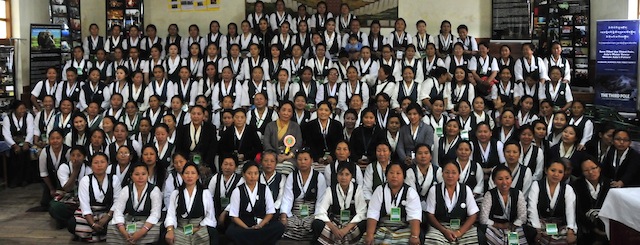
Following the 1959 invasion, many Tibetan women fled across the border, seeking asylum along with His Holiness the Dalai Lama. When these women reached Kalimpong, East India, they worked to establish an organization for women in exile. As the women in Tibet were struggling to find steady footing, the women in exile fought to help them from the free side of the border. Although in those days some ninety-nine percent of the members were illiterate, with selfless service and dedication, they demonstrated their capabilities and made sizeable achievements in politics, social welfare and other fields.

On September 10, 1984, under the advice and guidance of His Holiness the Dalai Lama, the Tibetan Women’s Association (TWA) was reinstated in Dharamsala, India, the present seat of the Tibetan government in exile. The TWA took off at once as a bird does to the sky and quickly gained a reputation on the world stage, rubbing shoulders with women from progressive countries and discussing issues with them in roundtable forums as equals.

Since its initial inception in 1959 in Lhasa, Tibet, the Tibetan Women’s Association has made unwavering efforts in mobilizing political participation, in the preservation and promotion of Tibetan religion and culture, in building the identity of Tibetan women and in empowering women on the educational and leadership fronts.

The TWA incorporates Buddhist nuns within the scope of its work to ensure that all sections of Tibetan women benefit equally. For this purpose, it set up the Tibetan Nuns Project that reaches out to Buddhist nunneries in other Himalayan regions as well as to nuns in other countries. The nuns themselves have worked very hard, have made great progress, and have achieved a great deal in the field of education, and continue to persevere further. This precious journey is not by a few nuns nor for a few nuns but for generations of Buddhist nuns to come. In the effort to become modern, they have not misplaced their souls.

His Holiness the Dalai Lama has over the years expressed His deep admiration and gratitude for His countrywomen in their fight for Tibet’s freedom. During a special audience for the members of TWA in 1995, His Holiness said that “Tibetan women hold a powerful significance in rebuilding their community and offering outstanding examples of spiritual and peaceful leadership to the world.’ TWA strives to justify the confidence he has placed in Tibetan women.

Women’s struggle persists

More than fifty years later, Tibetan Women lead the revolution that is now two-fold: inside and outside of Tibet.

Women inside Tibet:

Despite suffering losses owing to the worsening political situation inside Tibet, women inside Tibet have resisted Chinese repression and risen beyond the horizon. Their perseverance is palpable and laudable. Since 2009, more than a hundred Tibetans have resorted to self-immolations as a form of political protest and of them more than a dozen are women. They called for the ‘dignified return of His Holiness the Dalai Lama back to Tibet,’ and ‘freedom inside Tibet’ even in their final acts of defiance.

Image

Brave contemporary women writers in Tibet like Tsering Woeser and Jamyang Kyi continue to write and express despite threats of detention and torture. Woeser’s gallant writings on her blog ‘Invisible Tibet’ challenge the Chinese Government despite being under house-arrest. The series of international recognition conferred on to her speaks to the effect of the valiant and indomitable spirit of Tibetan women inside Tibet.

Image

In exile: from their principal refuge in Dharamsala to small settlements scattered across the globe, Tibetan women have become the architects and builders of the new Tibet in exile. In exile, woman like Jetsun Pema is revered as Amala, the Tibetan word for mother. Her tireless contribution to champion the cause of education and empowerment of Tibetan children in exile remain phenomenal. The University of San Francisco president Stephen A. Privett while honoring Jetsun Pema with an honorary doctorate degree in December 2012 said, ‘she models the Jesuit ideal of being a woman for others.’[xi]

Image

Having faced imprisonment in Chinese prisons in Tibet for twenty-seven years, Ama Adhe, now 77, lives in exile and speaks to the world about how she endured endless torture but never lost courage; she stands as a living testament to a woman’s strength and spirit in times of adversity. “I am free now. There are no guards outside my door. There is enough to eat. Yet an exile can never forget the severed roots of beginnings, the previous fragments of the past carried always within the heart. My greatest desire is to return to the land of my birth, writes Ama Adhe in her book ‘A Voice that Remembers.’[xii]

For women inside and outside Tibet, their goal is singular—to nurture the future generations and to inculcate in them the knowledge of their cultural heritage, spiritual wisdom and strength of character. Tibetan women continue to share the wisdom and fortitude that bridge their worlds, ancient and contemporary. Their stories are a celebration of the female spirit.

Tibetan women have received messages of encouragement from His Holiness the Dalai Lama, who stated: ‘Today, when there is a new understanding among the women in the Tibetan community, and the assumption of new responsibility among them, leading to the gaining of a new experience, there is a new determination and fruitful results in endeavors undertaken in every aspect of public life. When, thus, the term ‘Tibetan women’ becomes a recognized force on the world stage, I am gladdened by a new sense of happiness and pride; and I have a new sense of confidence.’ [xiii] The spectacular story of Tibetan women warrant the confidence and conviction His Holiness placed in them.

English poet Mathew Arnold (1822 – 1888) is said to have predicted that, “If ever the world sees a time when women shall come together purely & simply for the benefit of mankind, it would be a power such as the world has never known.” [xiv] Undeterred and unyielding, Tibetan Women have seen light in the abyss, have become the beacon of hope, the bastion of optimism and the illuminating light for the emancipation of the oppressed. Tibetan women, who have lost everything, survived decades in prison, and braved a perilous escape across the Himalayas have managed to transform the brutality of invasion into a community of compassion and courage, and of devotion and defiance.

References:

[i] Breaking the Shackles: 50 Years of Tibetan Women’s Struggle, Dharamsala: TWA Publications, 2009, pp-8.

[ii] http://tibetoffice.org/tibet-info/tibet-at-a-glance.

[iii] Breaking the Shackles: 50 Years of Tibetan Women’s Struggle, TWA Publications, Dharamsala, 2009, pp- xiv.

[iv]Goldstein Melvyn C, Jiao Ben, Lhundrup Tanzen,Chapter 6: The Capture of the Nun, pp. 137-161, On the Cultural Revolution in Tibet: The Nyemo Incident of 1969, University of California Press, Berkeley, Los Angeles and London 2009.

[v] Light in the Abyss, TWA Publications, Dharamsala, 2009, pp. 51.

[vi] Song twelve, “Songs from a Tibetan Prison: 14 Nuns Sing to the Outside World” in News from Tibet, October-March 1994, TIN News Review, Tibet Information Network, London, 26 April, 1994, pp. 18-21.

[vii] Light in the Abyss, TWA Publications, Dharamsala, 2009, pp. 38

[viii] Song thirteen, “Songs from a Tibetan Prison: 14 Nuns Sing to the Outside World” in News from Tibet, October-March 1994, TIN News Review, Tibet Information Network, London, 26 April, 1994, pp. 18-21.

[ix] Craig Mary, Tears of Blood: A cry for Tibet, Counterpoint, Washington, 1992, pp. 308.

[x] Tears of Silence, TWA Publications, Dharamsala 2009, pp-105.

[xi] http://www.usfca.edu/templates/ocm_media_relations.aspx?id=6442479019

[xii] The Voice that Remembers: A Tibetan Woman’s Inspiring Story of Survival, Wisdom Publications, Boston, 1997

[xiii] http://www.tibetanwomen.org/news/2009/2009.09.10-twa_silverjubilee.html

[xiv] http://humanrightsscc.org/wise-words-for-organizers/

China’s Fear Remains Even After Tenzin Delek Rinpoche’s Death

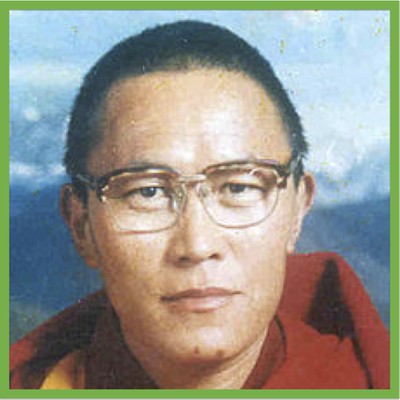
Tezin Delek Rinpoche_photo source-Students for a Free TibetTibetans across the world were devastated by the news of Tenzin Delek Rinpoche’s death in a Chinese prison on July 12 this year.

The news opened fresh wounds for Tibetans who called his death a protracted political murder. Tibetans in Tibet braved gunshot wounds to protest against his death. A series of actions continue to take place across the globe with exile Tibetan activists shutting down numerous Chinese consulates, hanging giant banners in front of Chinese embassies and holding candle-light vigils and rallies — urging an ‘international investigation’ into his death and the release of his family. Global leaders and lawmakers have echoed these demands.

Tenzin Delek, 65, is a Buddhist religious leader and a social worker. He first came under Chinese government’s scrutiny in 1987 when he returned from India after meeting with the Dalai Lama. As a spiritual leader, Tenzin Delek’s influence extended far beyond. But it was his strong advocacy for Tibetan cultural identity and Tibet’s environment that posed serious threat to China’s legitimacy in Tibet. His efforts in conserving Tibet’s environment by speaking against slapdash logging and mining projects, construction of old people’s home and setting up of schools for orphans made him not just a spiritual leader but an environmental advocate, social activist and a visionary.

In 2002, Tenzin Delek was arrested along with his distant relative Lobsang Dhondup on trumped up charges of their alleged involvement in bombings in Chengdu. Dhondup was immediately executed and Tenzin Delek was sentenced to death with a two-year reprieve. However, following international pressure, in 2005, his sentence was later commuted to life sentence. During the appeal hearing in 2003, he said, “I have neither distributed letters or pamphlets nor planted bombs secretly. I have never even thought of such things.”

Tenzin Delek’s innocence was reinforced when in 2004, Human Rights Watch stated that the legal proceedings against Tenzin Delek Rinpoche had been “procedurally flawed” and he had been charged to “curb his efforts to foster Tibetan Buddhism and his work to develop Tibetan social and cultural institutions.”

Tibetans in Tenzin Delek’s home county of Lithang, in eastern Tibet have fearlessly made steadfast efforts to secure his release. In 2009, 40,000 people risking arrests and even death, signed with red ink thumb impression, a petition calling for his release.

While demanding the release of his body, many local Tibetans sustained injuries from gunshot. His sister Dolkar Lhamo made a five-point appeal letter to the Chinese authorities citing a provision in its law that allows families to plea against cremations of prisoners. Lhamo also questioned her suspicion that her brother’s death may not have been natural.

Within a matter of days, the authorities secretly cremated his body in a remote high-security prison facility with the attendance of his family members, who noticed the deceased had black lips and nails — heightening their suspicion surrounding his death.

After his followers were handed over the ashes by prison authorities, the police confiscated the ashes from them at a hotel in Lunding at gunpoint and threatened to throw it in a nearby river. A few days later, his sister and niece went missing.

Months before his death, Tibetans across the globe marked the 13th year of Tenzin Delek Rinpoche’s imprisonment and demanded that he be released on medical grounds. His family members in Tibet sought medical parole in accordance with the Chinese law, particularly the Prison Law of People’s Republic of China that provides for a ‘commutation from punishment and release on parole’. This effort gained considerable support from the international community, including the U.S. Congressmen Jim McGovern who called on the U.S. State Department to make his release on medical parole a priority. Tibetans were hopeful but this again was short-lived.

Tenzin Delek’s death points to China’s gross violation of the principles of Universal Declaration of Human Rights. It also reflects on China’s violation of the Standard Minimum Rules for the Treatment of Prisoners adopted by the First United Nations Congress on the Prevention of Crime and the Treatment of Offenders stipulating, “sick prisoners who require specialist treatment shall be transferred to specialized institutions or to civil hospitals.”

This sad tragedy also mirrors the failure of the United Nations Human Rights Council, who despite objection from millions of people inducted China – considered to have the worst human rights violation record– into its membership fold in November 2013.

Tenzin Delek’s arbitrary imprisonment and his death under suspicious circumstances illustrate China’s definition of justice pandered to its own premeditated conclusions. His case is strikingly similar to the detention and eventual deaths of two other Tibetan religious leaders – the 10th Panchen Lama in 1989 and Khenpo Jigme Phuntsok in 2004.

The 10th Panchen Lama, a spiritual leader and a strong advocate of Tibetan culture, and author of 70,000-Character Petition, died under mysterious circumstances a few days after his trenchant criticism of China’s policies in a speech at his monastery Tashi Lhunpo in central Tibet. Similarly, Jigme Phuntsok, the head of Larung Gar Buddhist Institute, died unexpectedly at a Chinese military hospital in Chengdu in early 2004.

These prominent Tibetans, who were more than just spiritual masters, played varied roles such as social worker, educator and advocate of Tibetan cultural identity. They were also a binding force that brought unity among Tibetans and mobilized confidence in Tibetans to assert their rights in the face of China’s hardline policies. They hence became targets of China’s increasing surveillance, intimidation that possibly led to their deaths.

China’s rule in Tibet clearly constitutes sentiments of fear, suspicion and frustration, clearly reinforced by their policies of discrimination and oppression that dictates to their moral agencies based on fear, resentment and retaliation.

For 13 years, Tibetans have been vested in the fight for Tenzin Delek’s release. A new generation of Tibetans with unanswered questions stand witness to the most disparaging treatment of a Tibetan hero’s death by the Chinese government.

In these tragic spates of events, what comes to light is China’s persistent fear of Tenzin Delek, even in his death.

China feared Tenzin Delek’s growing influence and they feared him while he was in prison. His life has inspired a generation of Tibetans to continue to struggle for their rights.

China now fears him in his death. They fear realizing that his death has actually emboldened a million others to carry forward his work, legacy and spirit.

Tenzin Delek Rinpoche is no more, but his mission lives on.

China’s fear remains even after his death.


Contributors: Tenzin Jigdal and Dhardon Sharling

Tenzin Jigdal is the International Coordinator for International Tibet Network, a global coalition of Tibet-related non-governmental organizations.

Dhardon Sharling is a member of Tibetan Parliament in Exile and Co-chair of Steering Committee, International Tibet Network

Vital Underpinnings of Tibetan Feminism


Participants of TWA's ATWLT

Decoding Feminism:

The general notion of feminism in the Tibetan community is that it is a western import.   It is therefore scoffed at as “white feminism” – one that is unwelcome and struggling to find its footing on the Asian turf. In the general Tibetan discourse, feminism is seen as women coming together to stage an unwarranted battle of the sexes to deepen the social divide between men and women. A Facebook friend of mine who refers to himself as a patriot once commented on a link I posted. It read, “these burning feminists are good at turning their harmonious families into ashes!” Besides the hostile nature of the comment, what really bothered me was the fact that it came in response to my post about an interview I did with Radio Free Asia on women’s political representation in the Tibetan community in exile.

Any engagement on gender issues is always tied to the narrow perspective of feminism as merely “fighting for women’s rights.” The counter-argument posed in any discussion of feminism is, “When Tibetan women enjoy all the rights already, what is there to fight for?”

The central point missing in this argument, however, is that a mere false projection of a society where men and women enjoy equal rights does not undo the internalized, embedded gendering that has become part of the everyday experiences of women around the world. What we need to realize is that the misunderstanding of feminism as anti-man and as the exclusive domain of women is an inaccurate caricature that only further deviates from the achievement of gender equality. The misperception that gender equality already exists in our society obscures the very real gender biases and sexism, which in the long run will only create greater barriers to individual and collective action.

Although some feminist scholars such as Oyewumi[1] purport that mainstream feminism reinforces the idea of genderism, the premise that (cis)male dominance is universal and timeless, my personal belief in feminism is that it is based on the premise of ending (cis)male dominance of our society.

Gender Inequities in the Tibetan community:

Much of the gender-based discrimination in the Tibetan community is rooted in mythological and religious beliefs that are inherited from ancient traditional and historical practices.

As a native speaker, I see the Tibetan language as being highly gendered. The word for woman in Tibetan, for example, reads as ‘keth-men’ which translates to ‘lower-birth.’ Although we do not have an accurate historical account or a linguistic record of how that word came into being, it does bear a religious connotation; it is believed that “a woman’s body is impure because of puberty, and more susceptible to suffering than that of a man because of the pain endured during labor and the vulnerabilities associated with a woman’s body. Based on this reasoning, women are not allowed in many spheres of Buddhist rituals and practices because of their “impurity” and “lower-birth” status.

Religious influence often determines the construction of language, and in the Tibetan context both the religious and linguistic aspects are highly gendered. Another example being the Tibetan word for “female,” which is “buth-meth,” the etymology of which refers to the fact that the female reproductive organ does not protrude (out) like the male organ. The linguistic gap in regard to gender issues is palpable in the Tibetan language, as we still do not have an exact, agreed-upon Tibetan word for gender, feminism, or sexism. Depending on the speaker, these words and their meanings are ever-changing.

A common Tibetan profanity bears a metaphorical meaning which compares a woman to a drum, wherein the harder you beat it, the louder the noise it makes. The critical influence of language on shaping cultural norms is apparent when such metaphorical tools serve to justify forced penetration, therein encouraging male aggression and dominance during sexual intercourse, including marital rape.

That Tibetan culture and society is heteronormative and rooted in patriarchy is undeniable. The common belief and expectation in Tibetan families is that the daughter will eventually become a daughter-in-law. As such, the word ‘nama’ (daughter-in-law living with the husband’s family) is common terminology in mainstream Tibetan discourse. Tellingly, the word ‘Makpa,’ son-in-law living with the wife’s family, is rarely, if ever, used.

Moreover, in our exile society, women are expected to marry and produce more than three children in order to fulfill their patriotic responsibility and contribute to the continued growth of the Tibetan nation. The Tibetan understanding of queerness, the possibility of various gender identities and expression, cisgender,, transgender, gender non-conforming, and gender non-binary — is, thus, limited. Indeed, the general, deeply-ingrained understanding is that such identities simply don’t exist in Tibetan society.

Uphill Climb for Tibetan Feminism

Last July, while on a pilgrimage with my family to the highlands of Ladakh close to the Tibetan side of the border, I saw a life-sized billboard placed at an entrance to one of the oldest Tibetan Buddhist monasteries in Ladakh. The sign read, Ladies wearing pants are not allowed inside the Monastery. I was shocked by this message and couldn’t help but question the chauvinistic dictum — that ‘ladies’ (but not ‘gentlemen wearing pants somehow serve as objects of irreverence in our sacred Buddhist sites.

Thankfully, despite the grim circumstances for feminism and queerness in Tibetan society, one illuminating figure is our Tibetan spiritual leader, His Holiness the Dalai Lama. His Holiness has consistently championed the cause of women and gender justice across the globe and has been instrumental in the empowerment of Tibetan women (including nuns) in exile. At his ‘International Freedom Award’[2] acceptance speech, His Holiness made a comment “I call myself a feminist. Isn’t that what you call someone who fights for women’s rights?”

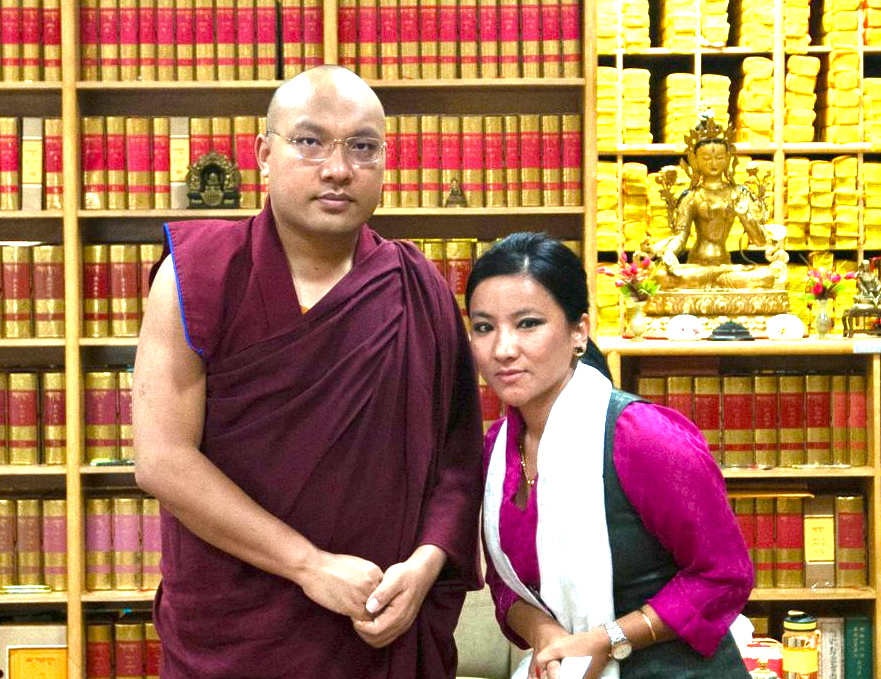
Another important spiritual figure who has been especially vocal in his support for gender equality is the 29-year-old Gyalwang Karmapa a staunch advocate of women’s empowerment. At a public talk recently held at Princeton University last April on ‘Buddhism, Environment and Gender Issues’, the Karmapa said,“Women’s rights are a reflection of the degree to which everyone enjoys basic human rights.” In his book[3] His Holiness the Karmapa makes a bold revelation in the chapter on ‘Gender Identities — It’s all in the mind,’ stating that “not everything in Buddhist institutions is perfect, and this is certainly the case when it comes to gender discrimination.” During a private discussion, in which I had the opportunity to participate, on the topic of gender issues, the Karmapa made a historic pledge to avoid using the word ‘keth-men’ due to it’s derogatory nature.

With two of the leading Buddhist feminists advocating the rights and freedom of women and calling for gender justice around the world, Tibetan feminism does stand a clear chance to thrive.

Women in general often suffer reprisals when they speak out about gender equality and feminism in our society. I, too, have personally not escaped the wrath of Tibetan patriarchy. As a women’s rights activist in our (cis)male-dominated Tibetan society, I have, admittedly, faced it all — the criticism, rejection, harsh judgment, shaming, unfounded accusations, and public discrediting for my outspoken and refusal to stay silent in my community, thus earning the wrath of angry Tibetan men who are on the offensive.

A few months ago, I saw a public comment posted by a Youtube user called “Tibet King” on a video released by the Central Tibetan Administration (CTA) on http://www.tibetonline.tv.[4] The video is an edited version of a panel discussion called “Prevention of Sexual Assault in Tibetan Community.”[5] I participated in this public discussion along with Tseyang Minyaktsang[6]in which we spoke at length about how sexual violence perpetrated against Tibetan women, particularly against minors, by Tibetan men not only violates the law of our host country, but undermines the very foundation of Tibetan culture. The Youtube user’s comments directed against me read: “Today she is dividing between genders and tomorrow she will take another topic to divide Tibetan society.. What results has she produced in Tibetan society due to her ‘ass hole’ workshops and lectures…Looks at the gals who follow her and listen her lectures..In the name of women empowerment they now consume alcohol, go to disco pubs, smoke, divorce and many even hesitating to marry. Fuck Dadon Sharling.”

We simply cannot remain oblivious to the internalized gendering and paternalism that abounds in such rhetoric. This comment, disguised in nationalistic undertones, is one of many blatantly sexist comments that is constantly directed against Tibetan women. There is no reason why a woman who chooses to live her life on her own terms is somehow antagonizing men so much that it requires them to moralize on the failings of Tibetan women.

There is nonetheless, a light at the end of the tunnel. I firmly believe that the scale of the backlash against us Tibetan feminists only reflects our growing visibility. This should reaffirm our commitment and conviction to continue working together to achieve gender equality in our society. We must carry on this uphill climb to strengthen the core of Tibetan culture. Feminism is meant to end gender discrimination and ensure equality of the sexes –not to privilege one gender over another. It, thus, requires the participation of both men and women (and all those in between or outside of this gender binary) to engage in this crucial work. The optimist in me sees this happening on the frontiers of Tibetan feminism.


[1] Oyeronke Oyewumi, “Decolonizing the Intellectual and the Quotidian: Yoruba Scholars(hip) and Male Dominance” in Oyewumi, ed. Gender Epistemologies in Africa: The Gendering of African Traditions, Spaces, Social Institutions, and Identities (Palgrave 2010).

[2] Award presented to His Holiness by the National Civil Rights Museum on November 23, 2009.

[3] The Heart Is Noble: Changing the World from the Inside Out (2013).

[4] Web TV of CTA, operated by the Department of Information and International Relations.

[5] https://www.youtube.com/watch?v=8Dfkj40cR9s

[6] The then coordinator for Women’s Empowerment Desk, Department of Home, CTA.

My Tribute to His Holiness the Karmapa Rinpoche

At a private audience with H.H. the Karmapa

རིག་པའི་གནས་ལ་མཁས་པའི་དེད་དཔོན་དང།།

ཀུན་ཕན་བྱམས་བཙེ་རིན་ཐང་སྦྱིན་ནུས་པ།།

ཁོར་ཡུག་སྲུང་སྐྱོབ་སེམས་ཅན་བྱམས་བརྩེ་ཅན།།

རླབས་ཆེན་ཀུན་སྙོམས་དབང་པོ་ཕྱག་གིས་ཡུལ།།

A Spiritual Crusader

An Environmental Advocate

A Feminist Icon

An Animal Lover

A Prolific Writer

A Steadfast Visionary

His Holiness the Karmapa Rinpoche

You are a divine gift for

Humanity at large and

For aspirants like me.

Prayers for His Holiness the Dalai Lama of Tibet

_DSC3339

༄༅། ས་སྟེང་ཡོངས་ཀྱི་བྱམས་བརྩེའི་བདག་ཉིད།

འཛམ་གླིང་ཞི་བདེའི་དེད་དཔོན་ཆེན་པོ།

བོད་མི་ཡོངས་ཀྱི་བླ་ན་མེད་པའི་མགོན་སྐྱབས།

བདག་གི་ཚེ་སྲོག་ལས་ཀྱང་རྩ་ཆེ་བ།

༧གོང་ས་སྐྱབས་མགོན་ཆེན་པོ་མཆོག་སྐུ་ཚེ་བསྐལ་བརྒྱར་བརྟན་ཅིང་བཞེད་དོན་ལྷུན་གྱིས་འགྲུབ་པའི་གདུང་ཤུགས་དྲག་པོས་སྨོན་ལམ་དང།

རང་ངོས་ནས་མགོན་པོ་མཆོག་གི་ཐུགས་དགོངས་བསྒྲུབ་རྒྱུར་སྒོ་གསུམ་གུས་པ་ཆེན་པོས་དམ་བཅའ་བརྟན་པོ་ཡོད།།

His Holiness the Dalai Lama

Global Icon of Peace

Ocean of Wisdom

Supreme Symbol of Tibetan Identity and Unity

The breath of my life

May you live for a hundred eons

While I pledge to make efforts to fulfill your wishes and aspirations

May I have the strength, forbearance and good fortune to tread the illuminating path you continue to show us.

Tibetan Women: off field, on field….

photo@Wen King and Jampa

This topic gained visual depiction when I sat watching the fitting finale of ‘Dhasa Women’s Basketball Tournament’ on the evening of October 27 this year.

Two reasons why I accepted this genial invitation to be the chief guest at the final series are-firstly, my dear friend Tseyang [1], backed by her devout friends had taken the onus to organize a series of civic initiatives in Dharamsala [2] oriented towards enhancing female participation in myriad avenues, and this basketball match for which she had worked painstakingly hard is a point in case. Secondly it’s a women’s match and I, for one would not miss witnessing women’s mastery descend on men’s field.

photo@Ngawang Sherab

Sitting at a special custom-made guest’s podium along with Tenzin Jigme, president of Tibetan Youth Congress, the largest Tibetan NGO with a predominantly male stronghold, at the famous Gangkyi[3] Basketball ground, the only leisure spot in the otherwise solemn space that hosts the Central Tibetan Administration[4], I felt ecstatic and excitable upon seeing hundreds of male spectators throng the ground. As the match progressed with the two male referees frisking about and ten women warm-up, I realized that this was going to be unique evening, beholding a spectacle, showcasing a hitherto latent talent of women, while men watched chanting boosterish slogans, thus shoving the usual flagrant reaction of booing into oblivion.

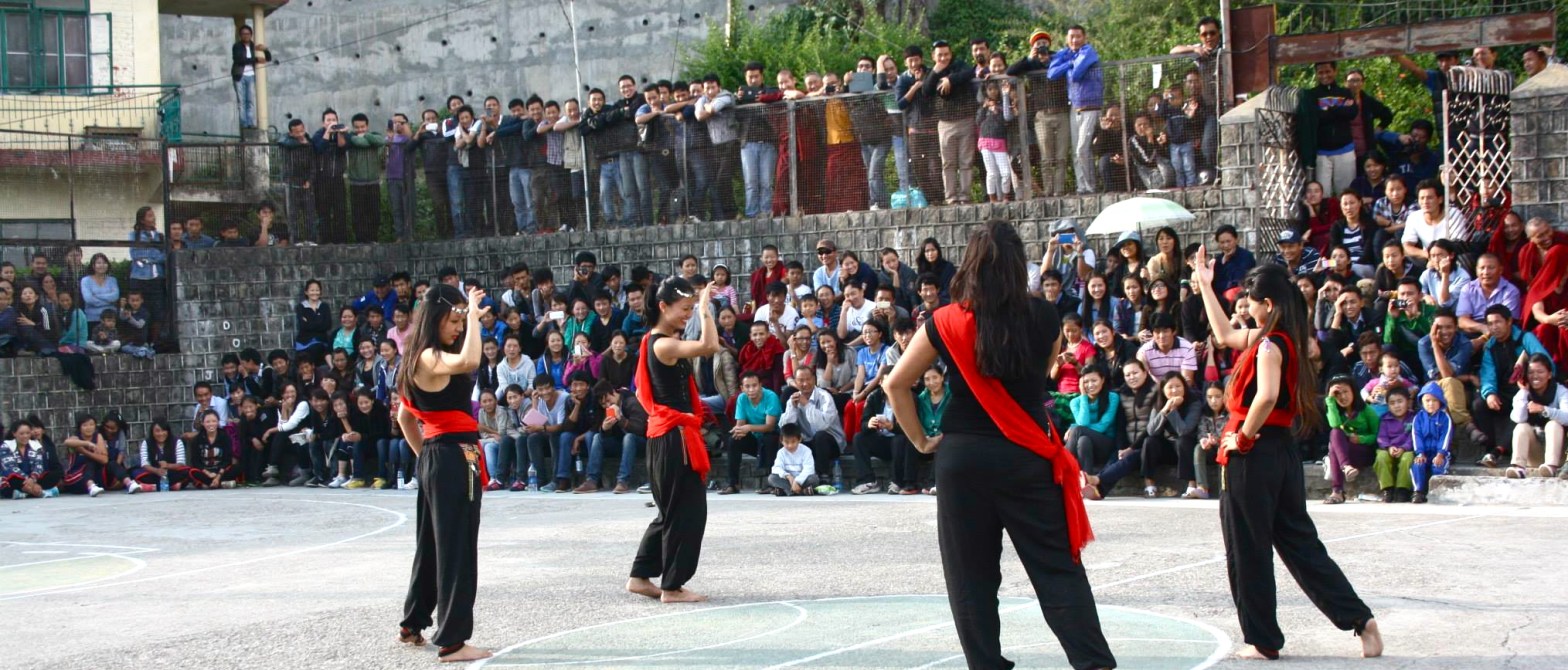
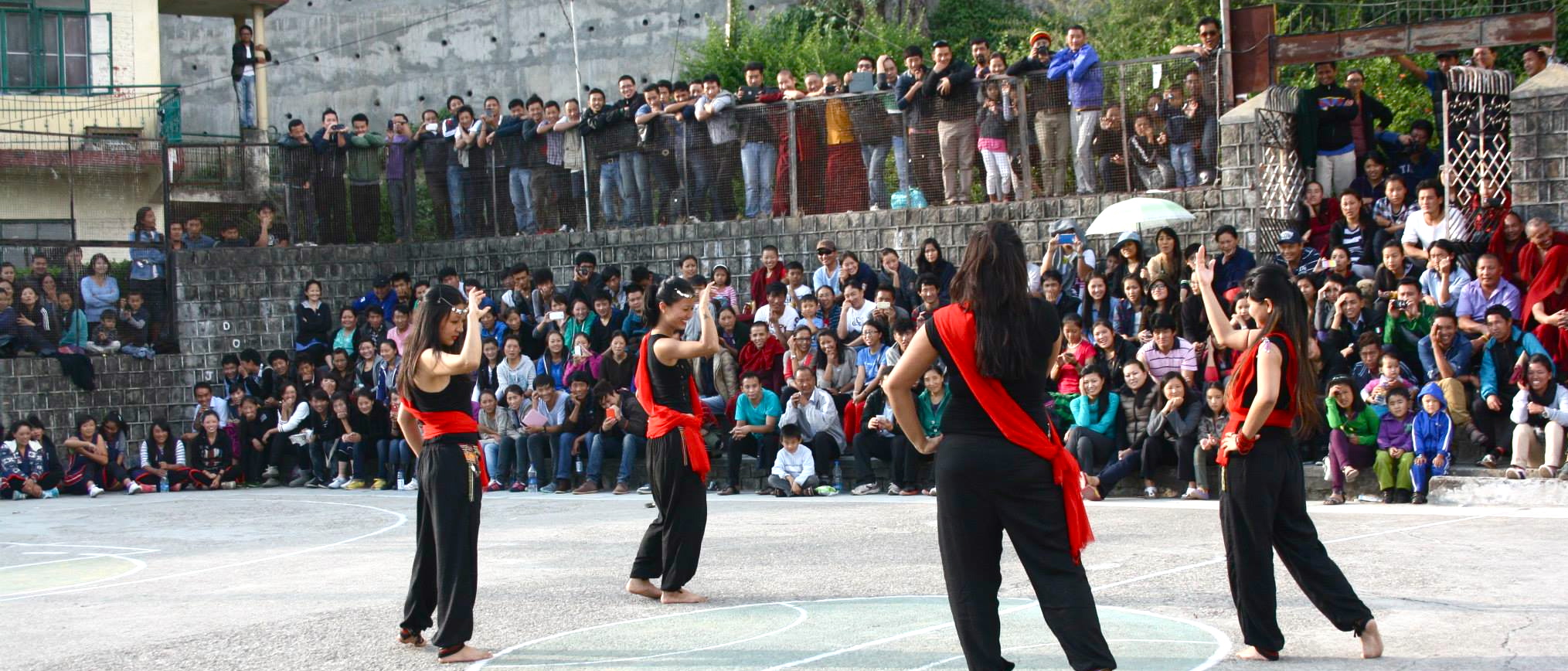
Prior to the match, four young, beautiful and talented women led by Dolkar [5] put up a spectacular Bollywood dance performance, grooving to the rhythm of the songs-Taal se Taal Mila, manifesting the graceful demeanor Aishwarya Rai embodied in the film Taal [6]and Maya Maya, an enchanting belly dance number from Guru.[7] Seeing that the scintillating show staged right in the middle of a ground guarded by men, was being received with the much gusto and grace and this left me feeling elated. The usual barbs and jibes gave way to applause, accolades and adulation. Looking at the performers, my friend Victoria who had accompanied me to the event, commented amidst the jarring cheering noise… ‘this is women’s leadership.’

photo@Ngawang Sherab

Ensconced on the edge of the lower terrain of Dauladhar hills, the basketball court measuring the dimensions 8.65m x 15.24m, has witnessed countless matches played on its terra firma, but between men. A comment by an expat Tibetan attests to this. “When I was a young man at Gangkyi, there was neither a basket court nor enough young ladies to field a team! I call it progress! Keep it up, ladies,” he posted online under a Facebook photo of the winning team holding the trophy, a photo that rightfully went viral.

The magnitude of this milestone event went notches higher when Radio Free Asia’s[8] Tibetan section reporter Yangdon Demo hosted a feature-length interview on this. Along with Tseyang and two players, I took part in the discussion. Tseyang presented a deeper insight into how sports and recreation bolsters a woman’s psychological and physical wellbeing and how this should be a daily feature in a woman’s life. I spoke about the significance of this event, and ended up deliberating, although inadvertently, on how this particular event actually effectuates the three guiding principles of a non-violent movement: unity, planning and discipline, as espoused by numerous strategists and visionaries. I concluded saying that this could potentially serve as a runway for a future events such as National Tibetan Women’s Basketball League (NTWBL) or an International Tibetan Women’s Basketball League (ITWBL).

During the course of watching the vigorous match, I realized that my mind was diverted, away from the match, away from being in the present to journeying between the past and the future. Besides the resounding cheers and the scoreboard carrying varying scores, I struggled to concentrate, as my usual dreamy side took over and I envisaged the recreation of this momentous equation at every spectrum of the exile Tibetan Diaspora: at grassroots, civil society, monasteries, workforce, education and matrimony.

My mind rattled between imagining the imposing vignettes of film footages, book excerpts and news headlines, all-encompassing the portrayal of women rising above their domain. A strikingly powerful resonation is a tagline from a Bollywood film Lajja [9] – ‘where tears stop, there, a revolution begins.’

A part of this euphoric feeling could be attributed to the changing global trend witnessing a palpable shift in recognizing women’s status as precipitant of a society’s commitment towards progress and prosperity. I have been particularly inspired by an increase in atypical news narrating women’s rise in the society, particularly in the religion and male dominated societies. The recent appointment of Isra al-Modallal, a 23-year-old female as a spokeswoman for Hamas, by the male Gaza authorities in Hamas, speaks to the effect of the invigorating movement, wherein men are being the catalyst in this social and political transformation.

A sense of accomplishment ran through me as I basked under the prospect of being in both the center and the periphery: in the center of powerful developments taking place in the Tibetan community and in the periphery of a global transfiguration, witnessing the end of an era, where females are treated as a chattel and considered a collective liability. The ushering in of a promising epoch, where women are recognized as forces to reckon with, is impending and inevitable.

Reverting back to my senses of being a guest at a match, and entrusted with the responsibility of giving away the trophy to the winning team, I felt bemused and wore a smile that didn’t wane down with the evening sun. My smile was sustained by a sense of infinite pride and hope, because I was not just merely watching a women’s basketball match but I was, bearing witness to a significant unfolding in the Tibetan community, for and of women: women at the forefront of unchartered territories and essentially women’s footsteps becoming visible and pertinent…….. from off field to, now, on field.


[1] 30-year old Tseyang is also the chief of Women’s Empowerment Desk of Central Tibetan Administration

[2] Home to over 10,000 exiled Tibetans is also the seat of exile Tibetan Government.

[3] Abbreviated name for Gangchen Kyishong, a Tibetan name for the Secretariat campus of Central Tibetan Administration

[4] the recognized name for Tibetan Government in exile

[5] 28-year old professional dancer, runs the D’shala Dance Arts in Dharamsala

[6] A 1998 Hindi love story film directed by Subash Ghai

[7] A 2006 Hindi drama film directed by Mani Ratnam

[8] A private, non-profit corporation broadcasting news and information in 9 languages.

[9] A 2001 Hindi drama film directed by Rajkumar Santhoshi.

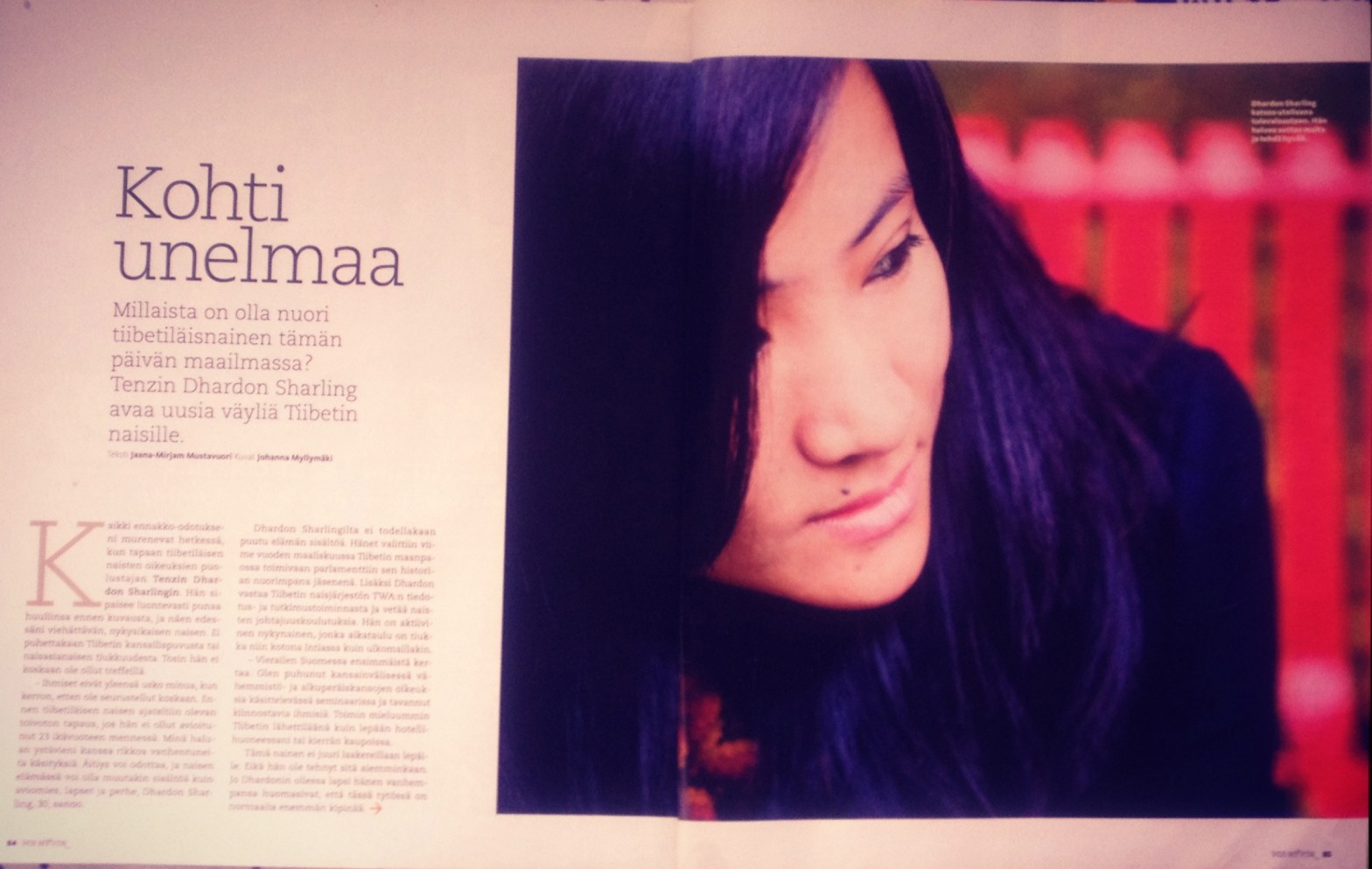
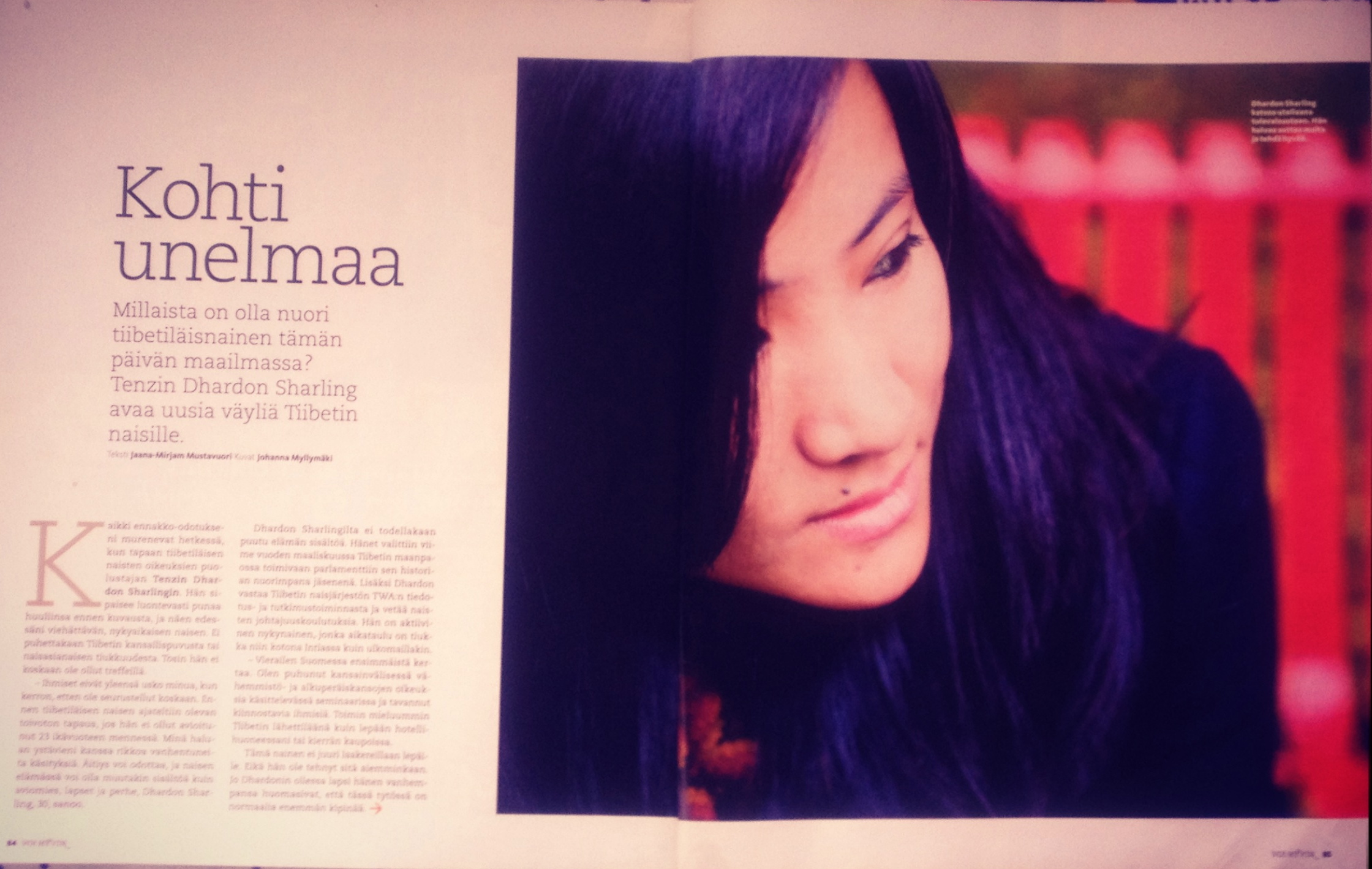
TOWARDS THE DREAM, How is it to be a Tibetan woman in today’s world?

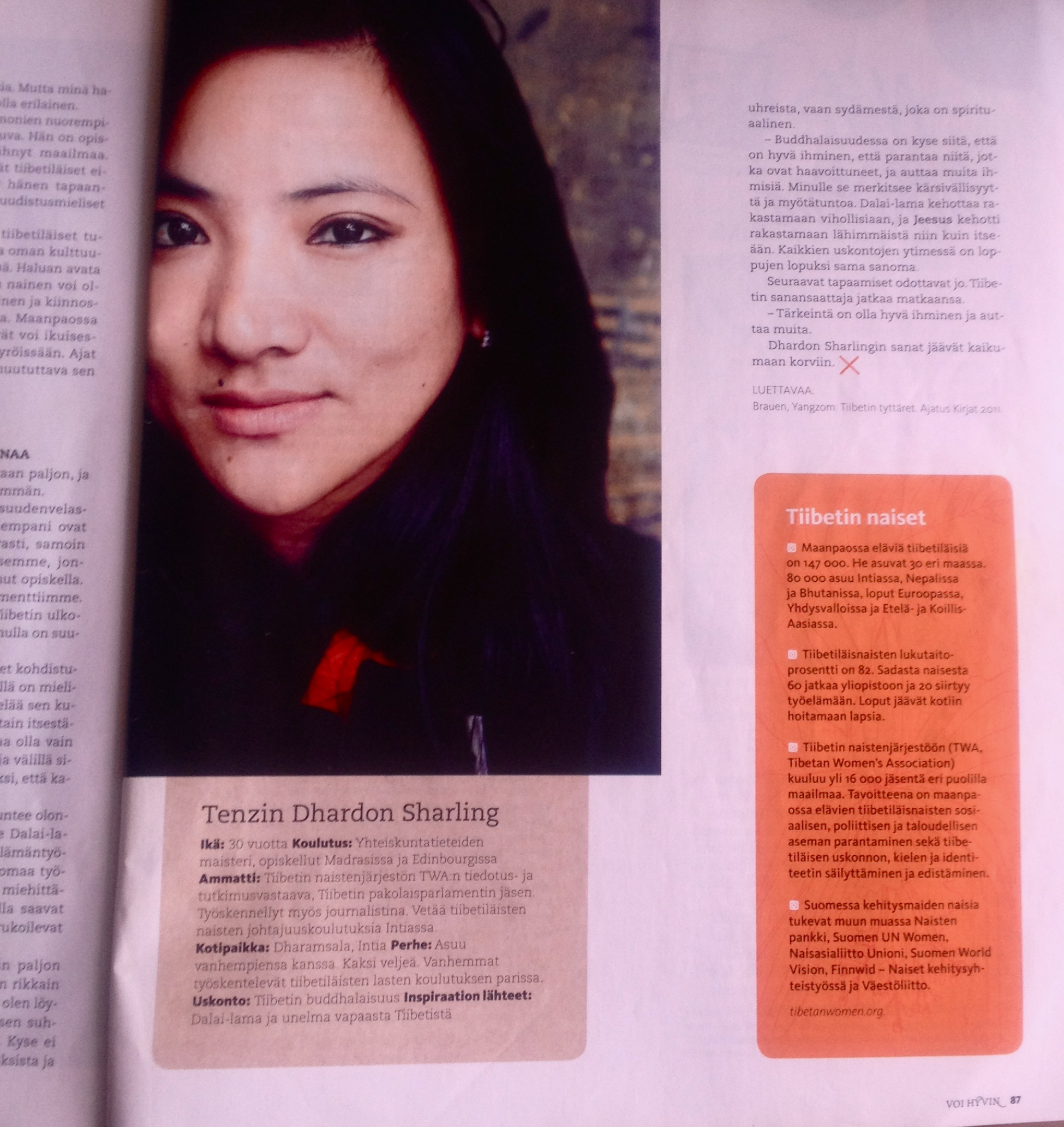
Tenzin Dhardon Sharling

Tenzin Dhardon Sharling opens new ways to Tibetan women.

Text: Jaana-Mirjam Mustavuori

Photos: Johanna Myllymäki

Source: VOI HYVIN (Finland’s lifestyle magazine)

Interview date: November 6, 2011

Place: Helsinki, Finland

Translation from Finnish to English: Erja Sini-Kaarina Varis, edited by Albion M. Butters

All expectations dissolve in an instant when I meet this speaker of Tibetan women’s rights, Tenzin Dhardon Sharling. She elegantly checks her lipstick before the photo session. I see a charming, modern woman in front of me. There is no mention of Tibetan national dress or the strictness of someone championing a women’s cause. Although she has never been on a date…

“Usually people do not believe me when I say that I have never dated. In the old days, a Tibetan woman was thought to be a hopeless case if she was not married by the age of 23. I want to break outdated models with my friends. Motherhood can wait, and there can be more in a woman’s life than husband, children and family,” says 30-year-old Dhardon Sharling.

There is truly no fullness missing in Dhardon Sharling’s life. Chosen to be a member of the Tibetan parliament in March of last year, she is the youngest member. Moreover, Dhardon is responsible for the Tibetan Women’s Association, including TWA’s publicity and research activities. She leads training in women leadership. She is an active, modern woman and has a tight schedule at home in India as well as abroad.

“I am visiting Finland for the first time. I have spoken in international minority and indigenous peoples’ rights seminars and met interesting people. I would rather work as Tibet’s envoy than rest in my hotel room or go shopping.”

This woman does not quietly rest on her laurels. Neither has she been that way in the past. Already as a child, Dhardon’s parents noticed that she has more of a spark in her.

The chain of descendants

Drahdon Sharling’s father was born in 1950, when the Chinese invaded Tibet. In 1959, the Dalai Lama had to escape to India with his close personal retinue. At the same time Dhardon’s mother and father also escaped, at the risk of their lives, as did tens of thousands of other Tibetans. Dhardon’s father’s mother died at forced labor camp in Tibet, and her grandfather had died earlier.

Dhardon’s mother was born during the flight on the border of Tibet and India, near Ladakh, where her family was staying. Her mother’s parents were Tibetan nomads, but in India they worked doing construction and helping new refugees.

Tibet in the 1950s was a feudal society with great class differences, where a woman’s role was to serve her husband and children. Yet the position of Tibetan refugee women has improved since then. Visiting the United States in 1979, the Dalai Lama was convinced by the power and abilities of local women. That very year the convention of women’s rights was accepted in the United Nations. Due to the Dalai Lama’s influence, the Tibetan Women’s Association was reestablished again to improve the position of Tibetan women.

“Lots of improvements have happened in thirty years. Most Tibetan women who live as refugees can read, and more than half of them continue their studies after compulsory school, although a lot of them stay at home to look after their children after completing a degree. Things are much worse inside Tibet.”

“Too many Tibetan women still have to sacrifice themselves for their families. I just met a talented girl who had to put aside her university studies in order for her brother to study abroad. Only three percent of Tibetans in a leadership role in exile Administration are women. We still have a lot [of work] to do in order for Tibetan men and women to stand on equal footing.”

Dhardon Sharling is Tibetan from head to toe. She dreams of freedom inside Tibet and fully advocates the rights of Tibetan women. But she is of the generation that has lived its entire life outside the borders of Tibet, surrounded by a rapidly modernizing India. Dhardon wants to break old concepts and be part of the creation of a future in which Tibetan women have more possibilities to influence their own lives and surrounding society.

IMG_1029Triumph through suffering


The world has changed a lot since Dhardon Sharling’s parents’ and grandparents’ youth. Dhardon was enrolled in an elite school in South India at the age of nine. Her parents had a low income and had to make great sacrifices so that their talented daughter could attend Indian private school. They borrowed money and had enjoyed fewer comforts in their own lives in order to meet the annual school tuition.

“I had problems adapting to the school, where there were only children from rich Indian families. I did not feel that I belonged there. I was Tibetan and had lived all my life in a Tibetan community in India. My family lived a simple life. I wanted to go back home.”

Slowly Dhardon adapted to the school. Today she gets along well with mainstream Indian culture. During her years of university in Madras, she surprised everyone by speaking Hindi, doing stage shows and winning prizes in Bollywood dance competitions and working as an “entertainment minister” whose responsibility was to organize fashion shows and singing and dance performances.

Dhardon mentions of a niche group that expects Tibetan women to be coy and reclusive. “Tibetan women should only be interested in Tibetan culture. She should not speak English. She should not cut her hair or wear trousers. She should not listen to anything but Tibetan music. But I want to live in modern times and be different.”

Dhardon Sharling is a role model for many young Tibetan women. She has studied abroad and seen the world. Yet all Tibetans in exile do not accept her way of going about things. Old-fashioned people and modern innovators have different approaches.

“Ther are Tibetans who suppress many things in the name of the preservation of their own culture. I want to open new paths. Tibetan women can by nature be dynamic, versatile and interested in other cultures. As Tibetans we cannot stay in our own duck pond forever. Times change and women have to change with them.”


IMG_1022Weight of gratitude


A lot is expected from Dhardon Sharling, and she demands even more from herself.

“I feel a depth of gratitude in many directions. Foremost to His Holiness the Dalai Lama and the the government-in-exile, who has invested a lot in me and due to whose stipend I’ve had a chance to study at the prestigious Edinburgh University. And now I have been elected to our parliament. I represent those living in Tibet as well as those in exile. I have a great responsibility.”

“Many Tibetans have an image of me, and sometimes I try to live accordingly, but then I lose something of myself. I never have time to just be by myself, to relax and enjoy, and sometimes the inner pressure grows so great that I lose contact with my inner-self.”

When Dhardon is feeling low and down, she thinks of the Dalai Lama’s life’s political and spiritual work. It gives her strength to continue her own work. The people inside the occupied country of Tibet also give her strength. All of the people there are praying and working for the Dalai Lama’s return.

“The Dalai Lama has given so much love. He is my greatest role model, and I have found a new relationship to Tibetan Buddhism thanks to him. It is not only a matter of rituals, prayers and offerings, but heart that is spiritual and mind that is practical.”

“Buddhism is about being a good human, who heals those who are hurt and helps other humans. To me it means probity and pragmatism. The Dalai Lama encourages us to empathize with one’s detractors, and Jesus asked to love others as one would love oneself. There is fundamentally the same core in all the major religions.”

The next appointments are already waiting and the spokesperson for Tibet moves on.

Dhardon Sharling’s words echo in my mind.

Exile – the Nursery of Nationalism

This article appeared in the April 2013 edition of  Seminar magazine.

http://www.india-seminar.com/2013/644/644_dhardon_sharling.htm

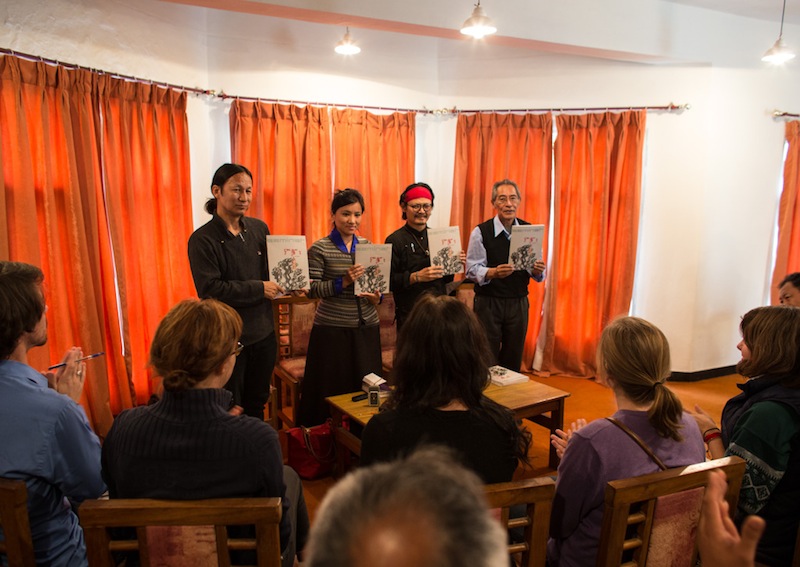
Tibet Writes organized a book launch event featuring a panel discussion on the Tibet issue.

“There is no greater sorrow on earth than the loss of one’s native land.” ( Euripides, 431 B.C.)


SINCE the beginning of the Chinese occupation of Tibet in 1949, approximately 1.2 million Tibetans have been killed, a figure denied by the Chinese Communist Party. ‘The estimate is not reliable because the Tibetans were not able to process the data well enough to produce a credible total. There were, however, many casualties, perhaps as many as 400,000,’ writes Patrick French.[i]

Monks and nuns are still imprisoned, and many Tibetans (mostly monks and nuns) continue -to flee Tibet every year.

The atrocities and Chinese persecution of the fleeing Tibetans caught the limelight when a Romanian mountaineer documented on camera a group of 80 Tibetan civilians who were trying to reach a refugee camp in Nepal, and came under fire from Chinese troops on 30 September 2006, resulting in the death of a 27 year old Tibetan nun, Kelsang Nartso and some others. ‘They were hunted like rats and were shot like dogs,’ the Romanian climbers, Alexandru Gavan and Sergiu Matei, reported. It became an international incident, causing widespread outrage when a Romanian TV station and BBC aired the video footage.

According to Article 1A (2) of the Refugee Convention, ‘A refugee is someone who owing to well-founded fear of being persecuted for reasons of race, religion, nationality, membership of a particular social group or political opinion, is outside the country of his nationality and is unable to or, owing to such fear, is unwilling to avail himself of the protection of the country.’

The Chinese government systematically attacks and tries to eradicate the cornerstones of Tibetan culture – language, monastic life and Buddhism. With no exercise of human rights, what is missing profusely is the freedom of expression, resulting in the Tibetan language and Tibetan culture coming close to extinction. Facing an increasing infant mortality rate and decreasing life expectancy, forced abortions and sterilization, Tibetans have become an ethnic minority in their own land. Article 5 of the Universal Declaration of Human Rights stipulates that: ‘No one shall be subjected to torture or to cruel, inhuman or degrading treatment or punishment.’

A large numbers of Tibetans first arrived in India in March 1959, after a failed uprising against the Chinese suppression that compelled the flight of the Dalai Lama into India. ‘Tibetan refugees arrived at the height of the Cold War, after Communist China asserted control over the region,’[ii] writes Susan Banki. More than 54 years after the exodus, the Tibetan population in exile now numbers around 130,000. (2009 census by the Planning Commission office of Central Tibetan Administration)

Tibetan refugees, transiting via Nepal to India, have to face many mishaps. Yet, tens of thousands of Tibetans continue to hazard the perilous month-long journey across the Himalaya. Even the sealing of the Chinese side of the border in 1960, has not managed to stem the flow in exile.

From the Old Testament to ancient Greece, Shakespeare’s fictional lover Romeo to the world’s spiritual leader His Holiness the Dalai Lama, stories of exile are an integral part of our historical imagination.

Born in exile in India, I can only reflect on it with innate nostalgia. ‘The moment of exile is, probably one of the most intense experiences in the lives of the individuals subjected to it’, wrote Ballinger Pamela.[iii]

Considered as foreigners under the 1946 Foreigners Act, the Tibetans have been accorded the basic rights of most citizens but are not allowed to contest or vote in Indian elections. Separate settlements were identified and established in geographically suitable areas so as to provide them with economic, social and religious autonomy. There is ever a fully democratic Tibetan Government-in-Exile established in Dharamsala, Himachal Pradesh. Yet, as Oivind Fuglerud said in 1999, ‘Exile is not primarily a geographical location; it is a state of mind through which one becomes what one has left behind.’[iv]

It is common to distinguish between internal exile, i.e, forced resettlement within the country of residence, and external exile, deportation outside the country of residence. The Tibetan story caters to both, but the focus is on the latter which is essentially a self-imposed departure from one’s homeland to avoid persecution.

The biggest fear after 54 years in exile is of cultural degeneration, in particular, the loss of  language. The Tibetan youth gets easily inclined to an alien culture and tends to integrate easily into the mainstream life of the host country. ‘I am more of an Indian, except for my Chinky Tibetan face’, states Tenzin Tsundue.[v]

Tibet is today a stateless nation, with an alien government controlling the country. Nevertheless, Tibet as a nation thrives in the spirit and psychology of the Tibetans, both inside and outside Tibet. Tibetan nationalism, in a nutshell, reflects positive nationalism and patriotism.

The upsurge of Tibetan nationalism, however, appears marked by a general outlook of moral ambivalence. It can be argued that to a large extent Tibetans did not have a full-fledged nationalism before 1950. But this does not mean that prior to 1950 Tibetans did not have any sense of themselves as belonging to a country. It was in the aftermath of 1959 protests that the awareness of belonging to a single country began to spread and this marked the birth of Tibetan nationalism.

But Tibetan nationalism has thrived in exile. The dominant religious character of nationalism is well captured in the Tibetan national anthem, modelled after traditional religious prayers used by Tibetans in exile to express their nationalistic aspirations. Under the strong influence of Buddhism, the exiled Tibetan looks at the Chinese forces as lacking in rationale and kindness.

The fiercest and bravest advocates of Tibetan nationalism are often young, in their twenties, deeply devoted to His Holiness Dalai Lama and their idea of Tibetan nationhood is clear, absolute and impassioned.

Tibetan nationalism in exile is a long-distance nationalism with the nationalistic struggle spearheaded by groups like the Students for a Free Tibet, Tibetan Youth Congress and Tibetan Women’s Association, often by relying heavily on digital activism. As Benedict Anderson points out ‘Newer examples of nationalism are the long-distance nationalisms of migrants like the Tamils in Norway working for their own state in Sri Lanka. Some of the most ardent Sikh nationalists are situated in Australia and Canada – thanks to the Internet and cheap airline tickets.’[vi]

September 1995, saw an early expression of Tibetan ‘female’ nationalism, when nine exiled Tibetan women successfully staged a peaceful demonstration in Beijing during the UN 4th World Conference on Women. From the Tibetan perspective, these women had created history by becoming the first Tibetans ever to hold a protest on Chinese soil.

Tibetan nationalism also reflects a deep moral tension between solidarity with oppressed Tibetans in Tibet and a growing resentment with more than half a century of struggle in exile. It often feels exasperated with international bodies and the key slogan for the March 10 Anniversary commemoration is ‘United Nations, we want Justice’. Yet, despite the pain and a feeling of desperation, it is the unconditional positive regard for their culture and faith that keeps the struggle going. ‘Three generations of Tibetans have lived through this darkest period of our history, undergoing tremendous hardship and suffering, yet the Tibetan issue is still very much alive.” (H.H the Dalai Lama, 2001)

H.H the Dalai Lama proposed a pragmatic solution of a peaceful Middle Way approach, seeking genuine autonomy within the framework of the PRC. In part, he was moved by the fear of the extinction of Tibetan culture in Tibet in the face of an overbearing Han Chinese culture becoming the dominant presence. This posed a difficult ideological shift: from claiming complete independence to a move for genuine autonomy within Chinese rule.

Tibetan nationalism thus reflects not a unified discourse, but rather serves as a site of contention, with conflicting visions competing for allegiance. There are many Tibetan nationalists who are markedly uncomfortable with benevolent nationalism. Nationalism also wore an antagonistic angle when eleven Tibetan protestors travelled from Hunsur, Karnataka state to Delhi, and hurled petrol bombs at the Chinese Embassy in New Delhi in 1992.

Then the astounding activities of Tenzin Tsundue, first breaching security, much to the embarrassment of the Indian government during the official visit by Chinese Premier Li Peng to India in 2001, and then scaling the 14th floor of the Oberoi Hotel in Mumbai to unfurl the Tibetan National Flag, during Chinese Prime Minister Zhu Rongji visit to Mumbai in January 2002. He completed a hat trick by breaching security at the British era building of the Indian Institute of Science (IIS) during the visit of Chinese Premier Wen Jiabao to Bangalore in April 2005, shouting anti-China slogans. ‘What revolutionary nationalism does in exile is to provide a name for individual nostalgia and shared exclusion from the host society.’[vii]

November 23 and 24 2006, saw new heights of patriotism with a nation-wide protest by Tibetans who literally chased Chinese President, Hu Jianto out of India, during his first state visit to the country. Needless to say that the host country India, was appalled by such nationalistic activity, forcing the Indian government to issue a deportation warning to the high profile Tibetan activist and writer Tenzin Tsundue, a week prior to 23 November 2006, in contravention of Article 22 of the convention that states: ‘No contracting state shall expel or return… a refugee… to the frontiers of territories where his life…would be threatened…’

Though the plight of Tibetans commands international attention, they have always had unsolicited counsel proffered to them from people with a strong interest in not offending China and yet desiring to be seen as caring about the issue of Tibet.

Tibetans in exile, which was hitherto an Indian affair, is today a global phenomenon. ‘Tibetans have also moved abroad, and adapted themselves very well.’ The most active and successful student-led activist group, Students for a Free Tibet (SFT), functions with its headquarters in New York and through its branch offices across the globe.

The quest for a Tibetan homeland can be seen in the emergence of narratives of nostalgia generated by Tibetans living in exile. Tibetans consider the Tibetan Plateau to be the ground on which their entire cultural and religious heritage was established. But exile creates situations in which the very basis of social memory and collective identity are reshaped. With every successive generation born into exile, the remaining vestiges of Tibetan culture are being gradually diffused.

Lord Acton (1834-1902), one of the great historians of the Victorian period made an aphoristic statement: ‘Exile is the nursery of nationalism’. Nationalism in exile sees the facades of both pros and cons in positive actions and unrestrained resentment, but truly it is only in exile that nationalism takes birth and gets nurtured.

Reflecting on the 53 years in exile, one can only wonder at the near miraculous unbroken ties of unity that knit the Tibetans strongly under the realm of a common goal and supreme faith in the spiritual leader, His Holiness the Dalai Lama. Disunity is the least feared factor.

It is only in exile that we can trace the nursery of Tibetan nationalism. Hoisting the Tibetan national flag, singing the national anthem, donning the walls with the portrait of the H.H the Dalai Lama and significantly working for the restoration of freedom inside Tibet, while a norm in exile, can easily become a cause for criminal conviction and prosecution in homeland Tibet.


Footnotes

[i] Patrick French, Tibet, Tibet: A Personal History of a Lost Land. HarperCollins, Delhi, 2003.

[ii] Oivind Fuglerud, Life on the Outside: The Tamil Diaspora and Long-Distance Nationalism. Pluto Press London, 1999. (Chap 8: ‘The Nature of Tradition’)

[iii] Pamela Ballinger, History in Exile: Memory and Identity at the Borders of the Balkans. Princeton University Press. Chaps 6 and 7, 2003.

[iv] E. Valentine Daniel, Charred Lullabies: Chapters in an Anthropography of Violences. Princeton University Press, 1996. (Chap 6: ‘Suffering Nation and Alienation’).

[v] Tenzin Tsundue, My Kind of Exile: Kora. Snowline Publications, 2003.

[vi] Benedict Anderson, Long-Distance Nationalism in Spectre of Comparisons: Nationalism, Southeast Asia, and the World. Verso London, 1998.

[vii] Benedict Anderson, Imagined Communities: Reflections on the Origin and Spread of Nationalism. Rev. ed., Verso, London, 1991.

References

Anthony D. Smith, Chosen Peoples: Sacred Sources of National Identity. Oxford University Press, 2004.

Richard Black, ‘Fifty Years of Refugee Studies’, International Migration Review, 2001.

Charles Bell, Tibet: Past and Present. Oxford University Press, London, 1968.

E. J. Hobsbawn, Nations and Nationalism since 1780: Programme, Myth, Reality. Cambridge University Press, 1990.

E. Gellner, Nations and Nationalism. Blackwell Oxford, 1983.

Georges Dreyfus, ‘Proto-nationalism in Tibet, Tibetan Studies, 1992.

Guy S. Goodwin-Gill, The Refugee in International Law. Clarendon Press, Oxford, 1996.

James C. Hathaway, The Law of Refugee Status. Butterworths, Toronto, 1991.

Jr. Smith Warren W., Tibetan Nation: A History of Tibetan Nationalism and Sino-Tibetan Relations. Westview Press. 1998.

Barbara Harrell-Bond and E. Voutira, ‘Anthropology and the Study of Refugees’, Anthropology Today, 1992.

Jhumpa Lahiri, Interpreter of Maladies. Flamingo, London, 1999.

N. Miscevic, Nationalism and Ethnic Conflict, Philosophical Perspectives. Open Court, La Salle and Chicago, 2000.

Turner, Stuart ‘Torture, Refuge, and Trust.’ in E.V. Daniel and Knudsen, 1995. pp. 56-72, University of Berkley press.

Electronic References

A Week With Bill Kauffman, Day Three, October 18, 2006. Access via http://www.2blowhards.com/archives/2006/10/a_week_with_bil_2.html
http://web.amnesty.org/library/engindex

http://www.ebeijing.gov.cn/Life/my_beijing/author/Wang_Yunkun/t697146.htm

http://www.nationalismproject.org/what.htm

http://www.phayul.com/news/article.aspx?id=14311&article=Dharamshala+condemns+Nangpa+Pass+Killings+in+Tibet

http://www.tchrd.org

http://www.tibetanwoman.org

http://www.studentsforafreetibet.org/2006/10/19/more-witnesses-to-nangpa-la-shooting

http://www.savetibet.org/advocacy/us/proceedings/senatefrmauramoynihan.php – 30k

http://www.tibetanyouthcongress.us/FORUM/viewtopic.php?

http://www.tibet.org/Activism/Women

http://www.unhcr.org/cgi-bin/texis/vtx/home

UNHCR (2006). ‘The State of the World’s Refugees: Human Displacement in the New Millenium’. Access via http://www.unhcr.org/cgi-bin/texis/vtx/home

UNHCR (Jan 2000). ‘State of the World’s Refugees: Fifty Years of Humanitarian Action-, Chapter 3: Rupture in South Asia, The Tibetan Refugee Community in India’. Access via http://www.unhcr.org/publ/PUBL/3ebf9bab0.pdf

UNHCR (Dec 2005) ‘Fundraising Reports: Global Appeal 2006’. Access via http://www.unhcr.org/publ/PUBL/4371d18e0.pdf

UNHCR (5 May 1971) ‘High Commissioner’s Statements’ Access via

http://www.unhcr.org/admin/ADMIN/3ae68fb330.html

Honoring Dr. Ama Jetsun Pema

amala

On a cold winter morning in December 2012, the mother figure for hundred thousands of Tibetan children stood tall amid the dignitaries, luminaries and students  of  the University of San Francisco  (USF).  Ama (mother) Jetsun Pema was being conferred with the honorary doctorate by USF.

The statement released by USF on the eve of the commencement ceremony lauded Jetsun Pema’s work for the “plight of Tibetan refugee children for more than forty years.”  The President of USF Privett remarked, “the University of San Francisco is proud to honor her life’s work and dedication to promoting peace in her country through caring for and educating its children. She models the Jesuit ideal of being a woman for others.”

While congratulatory messages poured in for Amala,  I paused to reflect on what a proud moment this is for all Tibetans inside and outside Tibet and for women around the world who work to champion the cause of education and empowerment.

This award among many others which Ama Jetsun Pema so rightly deserve adds credence to her indomitable role in rebuilding Tibetan lives in exile and reiterates her indispensable role in educating Tibetan children and in empowering Tibetan women. Her unflinching commitment, lifelong dedication and altruistic work towards creating a brighter future for our nation remain immeasurable. Her tireless and self-sacrificing efforts toward nurturing thousands of lives stand as a powerful inspiration to all of us to take pertinent role in building our nation’s future for sustenance, growth and prosperity.

Truly, Ama Jetsun Pema is the illuminating light for the emancipation of the underprivileged, a beacon of hope, and a  bastion of optimism. Dr Ama Jetsun Pema truly is in the words of USF President Privett “a woman for others,” living by the motto of the Tibetan Children’s Village schools she has single handedly managed for over four decades. The motto was and still is, “Others Before Self.”